

How does the daily diet affect the psyche of Poles?
During the holidays, we often joke about overeating and blame traditional foods for making us feel worse. Meanwhile, the largest study of Poles’ health to date — 1,196,102 participants in the National Health Test of Poles (2019–2024), conducted by experts from Wroclaw Medical University, among others — indicates that it is not the three days of Christmas that determine our mood and mental well-being. Daily eating habits, especially those related to the consumption of fast food and sweetened beverages, are much more important. The results show that the more often Poles reach for these types of products, the more often they report poor or very poor mental health.
“The most telling conclusion of this study is that there are clear socio-demographic inequalities in Poland in terms of diet, which have a real impact on physical and mental well-being,” emphasizes Dr. Mateusz Babicki, co-author of the analysis. “Younger people and those with lower levels of education were more likely to choose fast food and sweetened beverages, and these patterns were clearly associated with poorer self-rated health. The scale — nearly 1.2 million respondents — shows that these are not isolated cases, but a population phenomenon.”
It is worth looking at these relationships, especially now, at a time that for many people is associated with increased stress, pressure of responsibilities, and more intense snacking.
The Christmas menu and everyday life — two completely different worlds
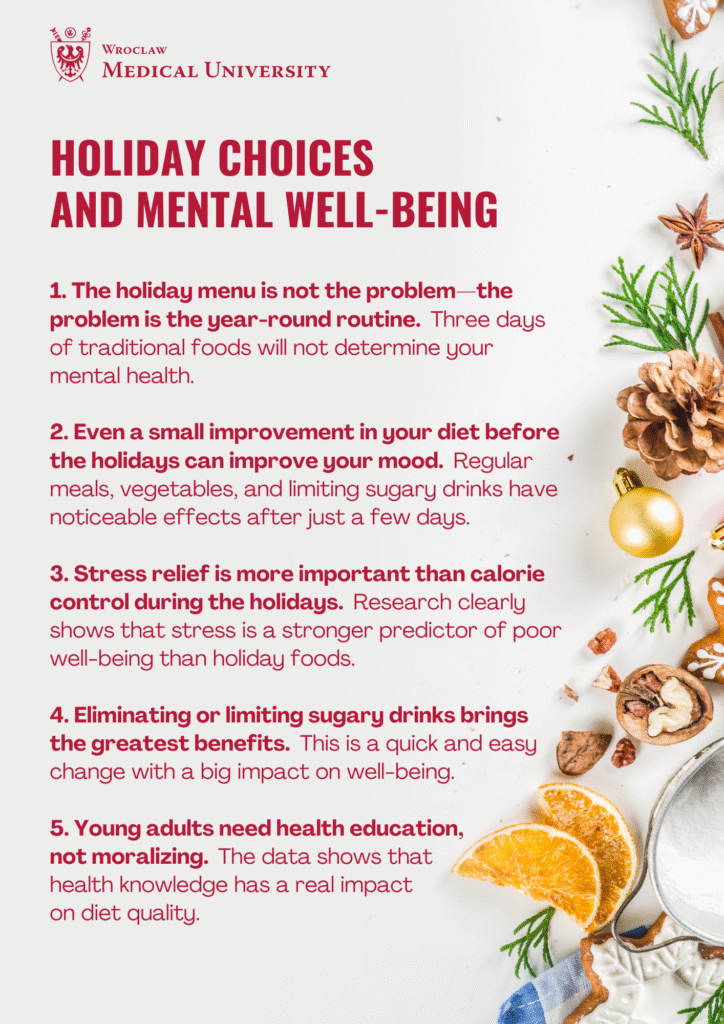
Hearty, traditional Christmas meals often raise health concerns, although in reality they are only a short-term departure from routine. Researchers point out that the problem lies not in Christmas Eve dumplings or festive desserts, but in everyday eating habits, shaped by haste, stress, and convenience. It is regular habits — not occasional feasting—that have a long-term impact on mental and physical health.
Analysis of data from over a million adult Poles made it possible to identify trends that were not visible in smaller studies. Among other things, the frequency of consumption of fast food, sweetened beverages, fruit, and vegetables was assessed, as well as the level of perceived stress and self-assessment of mental and physical health.
Daily fast food as a marker of poorer mental well-being
The most clear-cut correlation concerns regular consumption of fast food. In the group of people who eat it every day:
- 16.6% rate their mental state as “bad,”
- 6.7% as “very bad.”
This means that almost one in five people who eat this way report significantly reduced mental well-being. Similar trends can be seen with sweetened beverages and energy drinks — products that seemingly “boost energy” but in practice correlate with poorer mental and physical health.
“The most important observation is the clear link between frequent consumption of fast food and sweetened beverages and poorer self-assessment of mental health,” comments Dr. Babicki. “People who eat fast food every day were much more likely to report poor or very poor mental health. On the other hand, regular consumption of vegetables and fruit was correlated with higher subjective well-being.”
During the holiday season, when the rhythm of the day changes and stress increases, negative patterns may temporarily intensify.
“Even small, conscious choices — adding a serving of vegetables to your holiday plate, limiting sugary drinks — can have a noticeable impact on your well-being in the short term,” adds the researcher.
The key is the pattern of behavior
Holiday foods — although high in calories — appear incidentally and do not carry long-term risks. Meanwhile, everyday decisions such as:
- eating “on the go” in response to stress,
- ordering fast food after work,
- regularly drinking sweetened beverages,
- skipping vegetables and fruit,
- lead to a gradual deterioration in mental health. It is everyday choices, as the researchers emphasize, that matter most.
Conclusions and recommendations
“The results of the study emphasize the importance of introducing health education at an early stage of life,” concludes Dr. Mateusz Babicki. “Younger people are more likely to choose less healthy eating patterns and are more susceptible to eating disorders, which are strongly correlated with mental health. Educational activities based on reliable knowledge and practical changes can realistically improve the well-being of society.”
The holidays do not worsen our mental health. It is everyday life — filled with rush, stress, and fatigue — that shapes our mood, energy, and well-being. So maybe it is worth treating the holiday break not as a time of remorse, but as a moment of reflection on what our daily diet looks like — and how it affects us throughout the year.
This material is based on the article:
Socio-Demographic Disparities in Diet and Their Association with Physical and Mental Well-Being: Million-Participant Cross-Sectional Study in Poland
Nutrients 2025, 17(18), 2924
Grażyna Zweifler, Anna Zimny-Zając, MSc, PhD, MBA, Mateusz Babicki, Karolina Kłoda, Grzegorz Mazur, Beata Jankowska-Polańska, Agnieszka Mastalerz-Migas, Siddarth Agrawal
DOI: https://doi.org/10.3390/nu17182924