

We often treat intestinal infections as an episode: a few days of symptoms, elimination of the pathogen, and recovery. In this view, the disease has a clear beginning and end. However, patient experiences and clinical data increasingly show that for some people, the story does not end when the diarrhea subsides or the microbiological test results normalize. Chronic abdominal pain, intestinal hypersensitivity, bloating, and unstable bowel movements can persist for weeks or even months. In this context, there is increasing talk of “leaky gut,” or a breach in the intestinal barrier — but this term is often overused and oversimplified.
In the study “Impact of Isoquinoline Alkaloids on the Intestinal Barrier in a Colonic Model of Campylobacter jejuni Infection,” a team from Wroclaw Medical University shows that “leaky gut” in the course of campylobacteriosis is not a metaphor, but a specific, measurable biological process. The authors analyze how Campylobacter jejuni infection affects the large intestine and whether berberine, a well-tolerated intestinal compound, can modify this process.
Infection as a process damaging the intestine
Contrary to popular belief, intestinal infection is not solely about the presence of bacteria in the digestive tract. Campylobacter jejuni produces several factors that directly affect intestinal epithelial cells, leading to destabilization of their connections. It is these connections, known as tight junctions, that are responsible for the integrity of the intestinal barrier and control what can pass further into the body.
Intestinal infections, including invasive ones — the most dangerous — are associated not only with the presence of pathogenic bacteria, but also with damage to the delicate intestinal lining, which is crucial for the proper functioning of the intestines,- explains Anna Duda-Madej, MD, PhD, author of the study.
When this lining is damaged, the intestine loses its protective barrier function. Increased permeability promotes the penetration of bacterial antigens and inflammatory mediators, thereby sustaining the inflammatory response even after the pathogen has been eliminated.
Why dual action matters
In the model used by the researchers, berberine stood out for its action not being limited to a single level. On the one hand, it limited the proliferation of Campylobacter jejuni and significantly reduced the bacteria’s ability to form biofilms — structures that promote survival and prolonged contact with the epithelium. On the other hand, it had a clear protective effect on intestinal cells, stabilizing their connections and limiting the increase in barrier permeability.
-In our studies, we have shown that berberine overcomes both of these problems simultaneously,- emphasizes Dr. Duda-Madej. -This dual action is particularly important because even after the infection has subsided, the barrier itself may remain weakened, which contributes to prolonged symptoms,- she adds.
This observation has important clinical implications. An effective response to infection does not end with the elimination of the microorganism, but also includes the restoration of intestinal integrity.
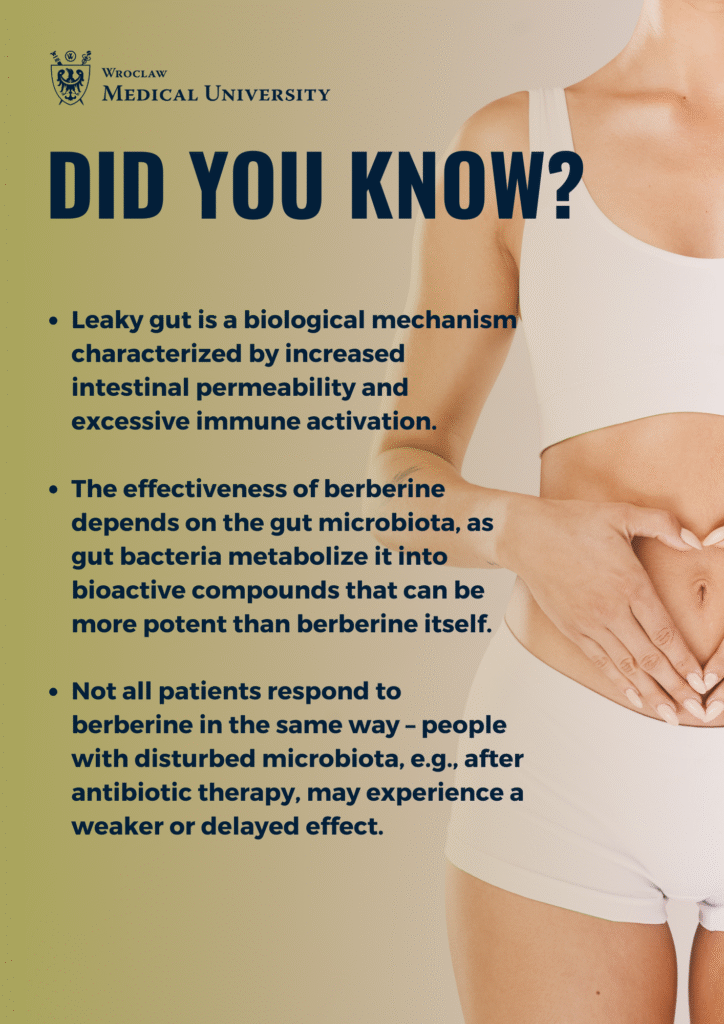
Where do chronic symptoms come from?
The study explains well why some patients do not return to full digestive comfort long after campylobacteriosis. Even in the absence of active infection, the intestine may remain functionally damaged.
-One of the reasons for persistent symptoms may be the so-called intestinal barrier leakage, a condition that promotes the permeability of bacterial antigens and inflammatory mediators, – explains the researcher.
In this context, berberine, by stabilizing intercellular connections, may promote the gradual restoration of the tight epithelial layer. This mechanism does not mean “curing” the infection in the pharmacological sense, but it does indicate the potential to support the intestinal regeneration process and limit the chronic consequences of the disease.
The study does not prejudge the clinical use of berberine, but it clearly shows that the intestinal barrier should be considered a key element in recovery from intestinal infections, rather than merely a passive victim of infection.
The material is based on the article:
International Journal of Molecular Sciences 2025,
DOI: doi.org/10.3390/ijms262110634
Authors: Anna Duda-Madej, Przemysław Gagat, Jerzy Wiśniewski, Szymon Viscardi, Paweł Krzyżek