

Is aging really inevitable? For decades, it was considered a biological necessity, as obvious and unavoidable as wrinkles, gray hair, and declining health. Today, however, the scientific picture has shifted. Research indicates that some biological features associated with aging can be modulated. This is not a quest for immortality or a search for a mythical elixir, but evidence-based science aimed at extending the years we spend in good health. The goal is not only to live longer, but to remain independent for as long as possible.
A team of researchers from Poland, the US, and the UK, led by Dr. Piotr Chmielewski from Wroclaw Medical University, has recently published a comprehensive review of current knowledge on aging and age-related diseases. The authors argue that certain biological aspects of aging appear open to modulation, at least in laboratory settings.
What drives aging?
Aging is not simply the passage of time, but a gradual loss of biological integrity, which leads to the development of various age-related conditions such as cardiovascular diseases, cancer, and neurodegenerative disorders. At the physiological level, as Dr. Chmielewski explains, aging is driven by the accumulation of molecular damage. Therefore, researchers observe genetic instability, epigenetic alterations, mitochondrial dysfunction, impaired proteostasis, and a decline in the efficiency of maintenance and repair systems that sustain homeostasis. Yet, as Dr. Chmielewski points out, the significance of these hallmarks of aging in terms of pro-longevity interventions remains to be fully understood.
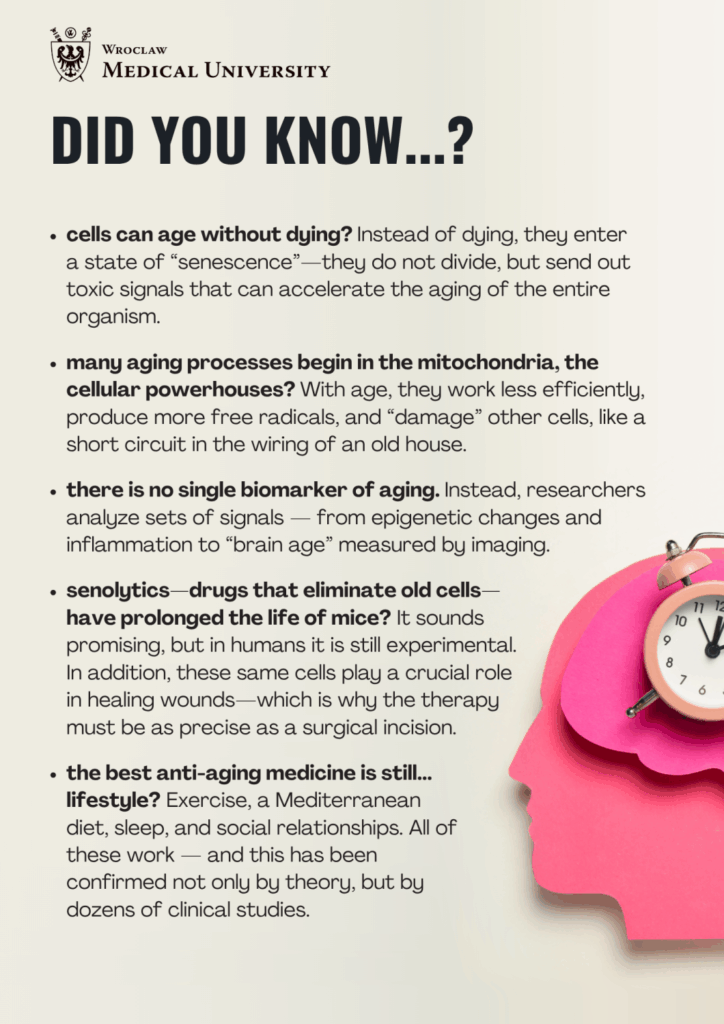
One of the key advances in recent years has been a clearer understanding of senescent cells and their role in aging. These are cells that no longer divide but also do not undergo programmed cell death (apoptosis). Although they have ceased to fulfil their original roles, they remain metabolically active and release bioactive molecules, known as the senescence-associated secretory phenotype (SASP). These factors can promote chronic inflammation and are associated with a higher risk of several age-related conditions, including cardiovascular disease, type 2 diabetes, certain cancers, and some neurodegenerative disorders.
“The controlled elimination of senescent cells is currently viewed as a possible therapeutic strategy” notes Dr. Chmielewski. He emphasizes that their accumulation can contribute to tissue dysfunction and increase the risk of age-related conditions. At the same time, he cautions that senescent cells are not merely harmful. “They also have beneficial roles, including supporting tissue remodeling and repair, enabling wound-healing responses, and providing short-term protection against malignant transformation. Therefore, future interventions will need to be context-specific.”
Senolytics and metformin: the future or a dead end?
Will agents such as senolytics or metformin eventually slow aging in healthy humans? The answer remains uncertain. Evidence from animal models is encouraging, but long-term clinical data are still limited. Dr. Piotr Chmielewski urges restraint. Metformin is safe and effective for treating type 2 diabetes, but its relevance for aging in healthy adults has not been demonstrated. The ongoing TAME study might provide important insights, but no conclusions can be drawn at present.
Exercise and diet
While new approaches attract attention, the most supported strategies remain lifestyle measures. Regular physical activity, balanced dietary patterns such as the Mediterranean diet, avoidance of tobacco and alcohol, and the maintenance of supportive social relationships reduce disease risk and lower premature mortality.
“These effects are documented in numerous prospective studies and meta-analyses” says Dr. Chmielewski. “In contrast, aging-modulating interventions remain at the experimental or preclinical stage.”
Tailor-made therapy
In the future, geroprotective interventions may become more personalized, based on individual miRNA profiles, epigenetic markers, or metabolic indicators. However, as the Wrocław-based scientist points out, this is still a distant prospect: “Personalizing interventions based on molecular, epigenetic, or metabolic profiles is a promising concept known as ‘personalized geroscience’. However, this concept is in its early stages of development and is far from practical clinical application.”
Aging – not a disease, but an opportunity for change
“Aging, as Dr. Chmielewski points out, is not a disease.” Attempts to treat it as though it were a single pathological process or to halt it outright, lack scientific support. The more constructive focus is to maintain health and independence for as long as possible without succumbing to simplistic solutions or exaggerated claims.
How to age healthily – 10 steps supported by science
- Exercise regularly. You don’t have to train like a marathon runner – a daily brisk walk (30–45 minutes), cycling, or dancing significantly improves the efficiency of your heart, muscles, and brain.
- Eat like you’re in the Mediterranean. A diet rich in vegetables, fish, olive oil, nuts, and legumes has anti-inflammatory properties, supports mitochondrial function, and can help delay biological aging.
- Avoid excess calories. It’s not about starving yourself, but about avoiding overeating. Even a small amount of caloric discipline supports repair processes and reduces oxidative stress.
- Take care of your sleep – not just the quantity, but the quality. Sleep deprivation disrupts cell regeneration, increases inflammation, and accelerates brain aging. Aim for 7–8 hours of good quality sleep.
- Maintain muscle mass. As we age, we lose muscle, which lowers our metabolism and fitness. Include strength training in your routine, even with light weights.
- Maintain social relationships. Loneliness is one of the strongest risk factors for mortality in older people. Meet up, talk, get involved—for your brain and your heart.
- Don’t smoke. Limit alcohol (or give it up altogether ;). These habits accelerate telomere shortening, damage DNA, and increase the risk of cancer and cardiovascular disease.
- Exercise your mind. A new hobby, learning a language, solving puzzles, or reading regularly—all of these activities support neuroplasticity and can delay neurodegenerative processes.
- Maintain metabolic balance. Monitor your glucose, lipid, and blood pressure levels. Metabolic diseases (e.g., type 2 diabetes) accelerate biological aging.
- Stay curious and flexible in your thinking. Your psychological approach to aging matters: People with a positive attitude tend to live longer and healthier lives. Optimism is also a biological intervention.
This article is based on: Human Aging and Age-Related Diseases: From Underlying Mechanisms to Pro-Longevity Interventions.
Aging and Disease
Authors: Piotr Paweł Chmielewski, Krzysztof Data, Bartłomiej Strzelec, Maryam Farzaneh, Dr.Amir Anbiyaiee M.D., Uzma Zaheer, Shahab Uddin, Mohadeseh Sheykhi-Sabzehpoush, Paul Mozdziak, Maciej Zabel, Piotr Dzięgiel, Bartosz Kempisty