The mouth vs. the lungs: how can bacteria from the teeth affect the respiratory system?
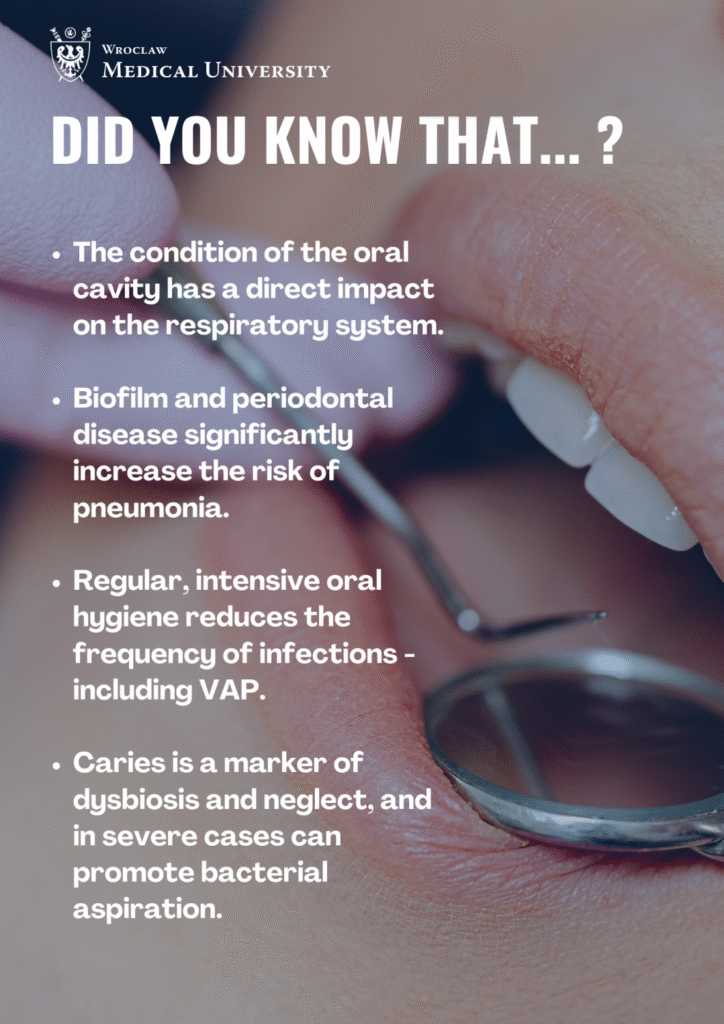
For years, it seemed that oral diseases and lung infections had little in common. However, a recent systematic review, conducted by a team of WMU researchers, including Dr. Jacek Matys and Prof. Maciej Dobrzynski, published in the Journal of Clinical Medicine, shows that the link is not only real but clinically significant. The results of more than 20 studies show that what happens in the mouth – especially the condition of the periodontium, the presence of biofilm, and disruption of the microbiome – can increase the risk of pneumonia, exacerbations of chronic diseases, and even deterioration of respiratory function.
Biofilm, periodontium, and microbiome – the invisible players
The data collected in the review show unequivocally: the worse the condition of the oral cavity, the greater the risk of lower respiratory tract infections.
As Jacek Matys, MD, points out, In light of the available data, the most clinically relevant elements of oral condition that can modulate the risk of lower respiratory tract infections remain primarily periodontal disease and the presence of an extensive bacterial biofilm.
Biofilm, or bacterial plaque – especially that lingering under the gums – is a reservoir of microorganisms that can be microaspirated into the lower respiratory tract. This paves the way for bacteria such as Klebsiella, Pseudomonas, Prevotella, and Veillonella, well known to pulmonologists as hospital pathogens.
Chronic periodontal inflammation is proving even more dangerous: It is the chronic inflammation of the supporting tissues of the teeth, induced by periodontal pathogens, that promotes both their colonization along the epithelium of the respiratory tract and the intensification of the local inflammatory response, which can reduce the resistance of the mucosal barrier. – explains the expert.
Oral microbial dysbiosis – a disruption of the natural composition of the microbiome – further reinforces the presence of bacteria typical of the respiratory system. Under such conditions, infections occur more easily.
Although periodontal disease plays the biggest role, the authors note that caries also matters – especially in advanced cases.
-Active caries appears to be of indirect importance, mainly as a marker of a disturbed oral ecosystem and inadequate hygiene; however, in advanced cases, it can further increase the risk of bacterial aspiration.
Oral hygiene saves lives
The review authors identified several studies from ICUs and nursing homes that unequivocally show that systematic oral hygiene significantly reduces the risk of pneumonia, including that associated with mechanical ventilation (VAP).
“Implementing standardized oral hygiene procedures is both feasible and clinically sound. The studies analyzed clearly show that intensive oral hygiene and regular dental evaluation significantly reduce the risk of pneumonia”, comments Dr. Matys.
Importantly, these are interventions:
cheap
safe
simple to implement
of proven effectiveness
The authors suggest that regular tooth brushing, biofilm removal, and dental evaluation should be a mandatory part of care for high-risk patients.
Why are we still not doing this? The expert identifies three main categories of obstacles:
1. Organizational barriers
Lack of formal oral hygiene protocols and poor collaboration between hospitals and dentists.
2. Educational barriers
Staff rarely receive training on the link between biofilm and pulmonary infections. This results in an underestimation of the role of oral hygiene in the prevention of nosocomial infections.
3. Cultural barriers
In Poland, oral health is sometimes treated as a secondary element – not as a component of systemic disease prevention.
Time for a change: integrating dentistry with pulmonary medicine
“Integrating dental care with the prevention and treatment of patients with respiratory infections should be considered as part of improving the quality and safety of care, not as an optional measure” – concludes Dr. Matys.
Introducing standardized oral hygiene procedures in hospitals could realistically reduce the number of severe respiratory complications – and even save the lives of ICU patients.
This material is based on an article:
The Role of the Oral Microbiome and Dental Caries in Respiratory Health: A Systematic Review
Łukasz Zygmunt, Sylwia Kiryk, Kamil Wesołek,Jan Kiryk, Izabela Nawrot-Hadzik, Zbigniew Rybak, Klaudia Sztyler, Agata Małyszek, Jacek Matys, Maciej Dobrzyński