

How can we tell a rash caused by an allergy from one triggered by a dangerous infection? Should a child with unusual skin lesions be kept in the hospital just in case, or is attentive observation at home enough? Soon, a pioneering tool developed by researchers from the Department and Clinic of Pediatrics and Infectious Diseases at Wroclaw Medical University will help doctors in outpatient clinics and emergency departments resolve such everyday dilemmas.
The Digital Atlas of Rashes is an educational platform that brings together the multi-generational experience of pediatricians in the area of childhood skin eruptions—now accessible in a mobile app. This interactive teaching tool is based on microlearning. It enables rapid learning, comparison of clinical images, and acquisition of practical skills in differential diagnosis.
As is often the case, necessity was the mother of invention. Rapid diagnosis of infectious diseases is crucial both for the child and their surroundings. Decisions about treatment, hospitalization, or isolation must be made swiftly. Yet this is not easy—not only because most childhood infectious diseases present with nonspecific symptoms.
“Correct diagnosis in pediatrics is becoming an increasingly difficult art. On one hand, fewer children are being born; on the other, infectious diseases are returning—diseases we haven’t encountered for decades,” explains Prof. Leszek Szenborn, head of the Department and Clinic of Pediatrics and Infectious Diseases at Wroclaw Medical University. “We have a growing group of patients with chronic conditions, including autoimmune diseases, treated with biological therapies that modify the clinical presentation of infections. Add to this the ubiquity of travel and exposure to pathogens unfamiliar in our climate zone. All this means doctors have fewer opportunities to see symptoms of many diseases—including dangerous ones requiring quick intervention—with their own eyes. This applies not only to young doctors entering the profession. Even experienced pediatricians can no longer rely on their own clinical experience because they have never encountered diseases that disappeared for decades thanks to mass vaccinations. Young doctors often have no one to learn from.”
The professor also stresses the ever-increasing speed at which diseases spread. As he notes, in the era of steamships, “Spanish flu” needed three months to disseminate. COVID-19 flooded the world almost instantly.
The foundation for creating the Digital Atlas of Rashes was an extensive collection of photographs of rash-related diseases taken over the years at the Clinic of Pediatrics and Infectious Diseases. A printed atlas of pediatric skin lesions had been regularly updated, resulting in an impressive set of materials now used in digital form.
“But our atlas is much more than a set of unique clinical photographs—which we will continue enriching with new cases,” explains Dr. Kamila Ludwikowska, one of the creators of the application. “We wanted to build a rapid-learning tool that allows users to compare clinical images and gain practical differential diagnostic skills. At the same time, we assumed that learning can be enjoyable, even game-like. That’s why the atlas includes a range of functions—both useful and user-friendly, tailored to modern learners.”
For practitioners, the Digital Atlas of Rashes will serve as a kind of “cheat sheet.” A five-step algorithm guides users through a logical diagnostic pathway—from hints on what to focus on and which questions to ask the patient, through diagnosis, all the way to management. With the search function, the physician can find and compare skin lesions, matching them to the patient. Is the rash macular, petechial, or vesicular? Is it a single lesion, and where on the body is it located? Every detail matters and must be recognized. Each photograph is accompanied by a concise description of the disease associated with a particular rash type and its location. The entire philosophy behind the platform is not merely to support immediate decision-making but to build lasting knowledge. This is reinforced by five-minute expert lectures—delivered by experienced pediatricians from the Clinic of Pediatrics and Infectious Diseases—offering highly condensed, practical guidance. Users can also complete engaging exercises, take scientific quizzes, and ultimately earn a Wroclaw Medical University certificate confirming their knowledge and skills.

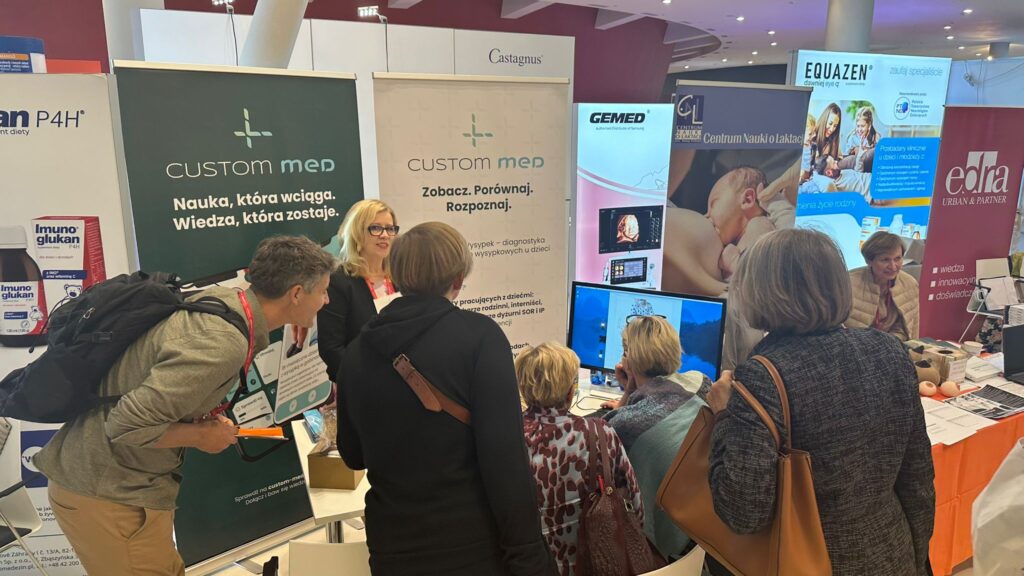
The Digital Atlas of Rashes is the first component of a broader educational platform, Custom-med, which will include an interactive system of courses and micro-modules in additional fields. In creating it, UMW researchers collaborated with Animativ—the same team with whom they previously developed the Kid AID app, which uses artificial intelligence to support early detection of sepsis in children. The new platform is expected to be fully ready by the end of the year and will be made available free of charge to UMW staff and students. Future plans include commercialization and subscription-based access for external users.
The platform was presented to specialists from across Poland during the 24th National Training Conference – Pediatric Autumn 2025, held on September 26–27 in Kraków