

In recent years, berberine has increasingly appeared in the public sphere as a “natural way” to improve metabolism. In social media, it is sometimes compared to incretin drugs and even referred to as “plant-based Ozempic.” Such comparisons suggest a simple mechanism of action and predictable effects. However, the review “Berberine in Bowel Health: Anti-Inflammatory and Gut Microbiota Modulatory Effects” shows that this narrative is an oversimplification that does not reflect either berberine’s mechanism of action or the scope of clinical evidence.
A team of researchers from the Wroclaw Medical University emphasizes that this alkaloid does not act as a hormonal drug and does not activate a single specific receptor. Its effect on metabolism is indirect, diffuse, and strongly dependent on the intestinal environment.
Metabolism begins in the intestine
From an experimental perspective, the mechanisms underlying the intestinal microbiota and its impact on inflammation and the integrity of the intestinal barrier are currently the best documented. It is at this level that berberine has the strongest effect.
-The best understood is the microbiotic level and its impact on the intestinal barrier and inflammatory processes,- points out Anna Duda-Madej, MD, PhD. -Therefore, the gut-brain axis remains the most promising, but its clinical significance still requires a lot of research,- she adds.
In practice, this means that berberine does not directly “control” metabolism but rather modulates the biological conditions in which metabolism occurs.
Why are the effects so different?
One of the key conclusions of the review is that individual variability plays a key role. Berberine does not act in isolation from the gut microbiota, and its effects are largely dependent on the composition and function of the intestinal microbiota.
-Berberine does not act in a microbiological vacuum. Its effects are largely microbiota-dependent,- the researcher points out.
This means that different effects may predominate in different people: anti-inflammatory, protective of the intestinal barrier, or metabolic. In patients who have undergone antibiotic therapy or have disturbed microbiota, the response may be weaker or delayed, which explains why berberine does not work “the same” in everyone.
Bioavailability as an element of biological logic
The review also touches on a topic often considered a weakness of berberine: its low systemic bioavailability. However, the authors point out that in the intestinal context, this may actually promote its action.
-Low bioavailability after oral administration means that berberine has an intense local effect in the intestine, where it is metabolized with the participation of the microbiota,- explains Dr. Duda-Madej.
It is this local metabolism that can lead to the formation of bioactive derivatives and modulation of the intestinal environment, which indirectly translates into the observed metabolic effects.
Why the “universal supplement” is a myth
The author of the review clearly distances herself from the media’s simplifications.
-The term ‘universal metabolic supplement’ is completely inaccurate,- she emphasizes. -A more appropriate term would be: modulator of the gut-microbiota-immune system axis,– notes Dr. Duda-Madej.
The researcher also draws attention to safety, which is often completely overlooked in online narratives.
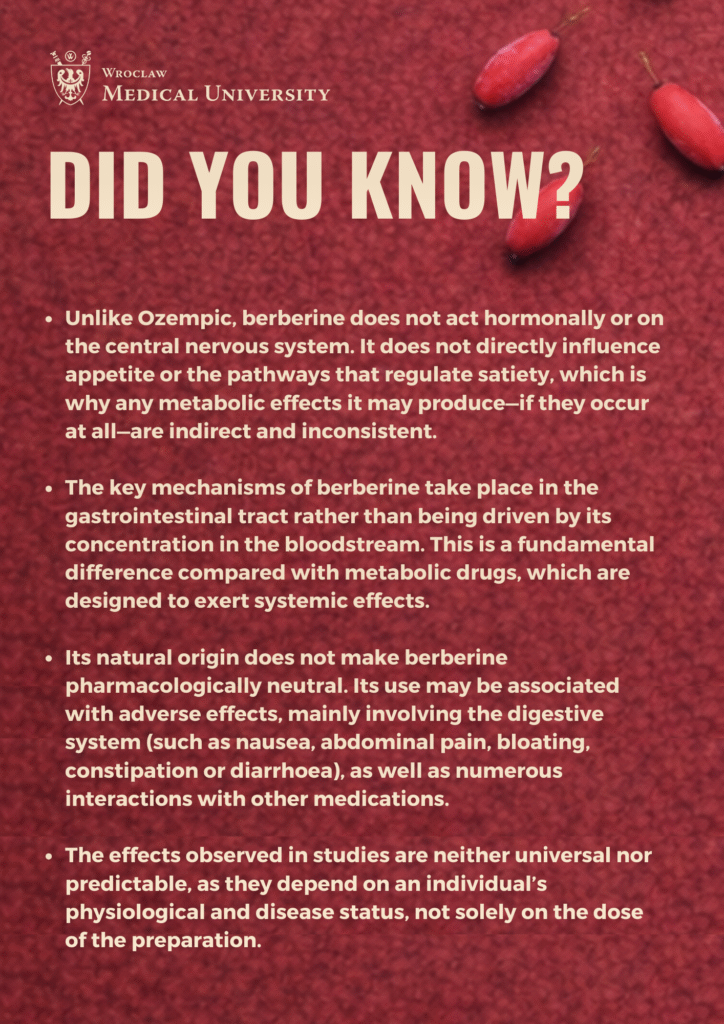
-According to information provided by the National Center for Complementary and Integrative Health, the use of berberine is primarily associated with adverse effects on the gastrointestinal tract, such as nausea, abdominal pain, bloating, constipation, and diarrhea. Importantly, berberine interacts with many drugs by inhibiting enzymes involved in their metabolism, including cyclosporine, metformin, antidiabetic drugs, anticoagulants, and sedatives. In addition, it can be dangerous during pregnancy and breastfeeding, as it can affect the fetus or infant, leading to bilirubin accumulation and the risk of brain damage. For this reason, berberine should be used with great caution and only under medical supervision,- the author emphasizes.
From a scientific point of view, berberine is not a substitute for pharmacological treatment or a “natural cure-all.” Rather, it is a compound that allows us to better understand how deeply human metabolism is rooted in the gut and how strongly it depends on interactions with the microbiota.
This material is based on an article:
This article is based on:
Berberine in Bowel Health: Anti-Inflammatory and Gut Microbiota Modulatory Effects
Authors:
Anna Duda-Madej, Szymon Viscardi, Jakub Piotr Łabaz, Ewa Topola, Wiktoria Szewczyk, Przemysław Gagat
International Journal of Molecular Sciences 2025