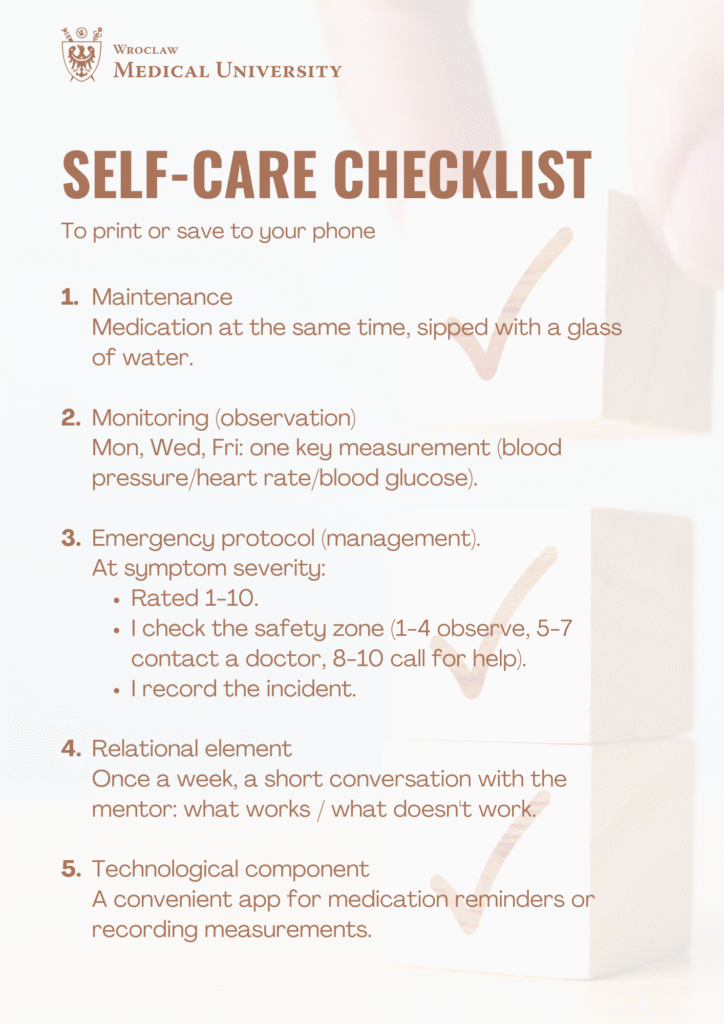
Provisions that make sense. Self-care in chronic diseases
Every year, with the beginning of January, we return to a familiar ritual: writing down resolutions. We promise ourselves to eat healthier, move more, and finally “take care of ourselves.” Yet the reality is different – more than 80% of such plans fall through within six weeks.
For people living with chronic diseases, self-care is a necessity built into everyday life. And, as an editorial published in Advances in Clinical and Experimental Medicine shows, a process that can be consciously shaped, developed, and effectively supported.
Why don’t mere resolutions work?
New Year’s resolutions are usually based on the idea of self-discipline – they assume that “wanting more” is enough. Meanwhile, chronic diseases require a completely different approach. In scientific terms, self-care is a complex system of behavior that:
involves the patient’s knowledge and experience,
requires conscious observation,
is based on consistency rather than willpower,
in many cases is a shared process with the caregiver.
Researchers emphasize that effective self-care consists of three elements. Together, they form a structure that does not need momentary enthusiasm – it needs regularity.
1. Self-care maintenance – take care in advance
Daily habits: physical activity, diet, sleep, and regular medication.
This is the foundation – the routine that maintains stability.
2. Self-care monitoring – observe to understand
Monitor body symptoms and signals, measuring blood pressure or blood glucose.
As Prof. Izabella Uchmanowicz points out, “The biggest challenge remains monitoring symptoms and interpreting them correctly. Patients often know what they should do, but are unsure when a particular signal requires a response.”
3. Self-care management – have a plan for a worse day
What to do when symptoms appear? When to call the doctor?
It’s a practice that keeps you safe.
Self-care in duo
In recent years, self-care has increasingly been analyzed as a relational phenomenon. Patient and caregiver form a system of interconnected vessels – the emotional state of one influences the behavior of the other.
Dyadic models clearly show that:
a burdened caregiver is less supportive of the patient,
moods transfer between members of the duo,
the effectiveness of self-care depends on the quality of the relationship.
Prof. Uchmanowicz points out: “The signal that the caregiver needs support is a decrease in his emotional availability – fatigue, withdrawal, irritability. This is the point at which the patient’s self-care is also at risk.”
That’s why one of the best solutions may be a simple, weekly conversation: what’s working and what’s stopping working?
New technologies
In the editorial, the authors note that self-care is entering a new phase. Technology and artificial intelligence are beginning to ease the burden on patients in real terms:
apps that analyze symptoms and signal the need for intervention,
remote monitoring of vital signs,
digital assistants to support medication, education, and organization of the day,
teleinterventions and VR to assist in rehabilitation.
As Prof. Uchmanowicz points out: “The greatest potential comes from tools that combine personalization with everyday usability – ones that realistically take the burden of interpreting symptoms off the patient.”
Polish context
Despite growing awareness, Polish patients still face the same barriers:
inadequate health education,
fragmentation of the system and lack of coordination of care,
cultural reluctance to ask for help,
the belief that “you have to manage on your own.”
low acceptance of technological solutions.
Prof. Uchmanowicz concludes: “In Poland, practical patient education remains the biggest barrier. Without it, even the best recommendations do not translate into behavior.”