

How to support students during a demanding time
Supporting students during exam stress is one of the most important challenges facing modern universities. The academic year has its own rhythm — weekly assessments, growing expectations, and finally exams, when pressure accumulates all at once. This period often means intensive studying, reduced sleep, and little space for regeneration. For many students, exam season is not only a test of knowledge, but also a significant mental and emotional burden.
Stress at such a time is a natural reaction of the body to the accumulation of demands. The problem persists for a long time and begins to affect well-being, concentration, and relationships with others. Then the exam period ceases to be just an academic challenge and becomes a source of chronic tension.
Overload with studying and exam stress
The mental strain builds up gradually. Prolonged concentration, the need to absorb large amounts of material, and limited time for rest cause the body to function in a state of constant arousal. Difficulties with sleeping, irritability, a feeling of lack of control, and sometimes anxiety and low mood appear. These are signs that resources are overloaded.
In a study on the quality of education and the mental well-being of pharmacy students in Poland, prepared by a team of students and researchers from Wroclaw Medical University, the authors highlighted factors that particularly increase tension.
As co-author of the study, Dr. Katarzyna Karłowicz-Bodalska, comments:
-According to students, relationships, a dismissive attitude, and the enormous amount of material, which in the students’ opinion is not always useful in their professional work, are stressful.
Exam stress as the most sensitive period for students
It is during the exam period that previous tensions accumulate. Long hours of studying, the pressure of deadlines, and the uncertainty associated with exams cause stress to take the form of anxiety and intense agitation, and sometimes it can cause helplessness and apathy. In such conditions, even well-prepared people may have difficulty concentrating or remembering.
Dr. Karłowicz-Bodalska points out another reason that, according to the students surveyed, intensifies negative feelings:
-Exams contain very detailed content that is not always discussed in class, which leads to increasing stress and fear.
When the exam period is experienced as an unpredictable situation, tension ceases to have a mobilizing effect and becomes exhausting. It is then easy to fall into a vicious circle: the greater the stress, the more difficult it is to study – the more difficult it is to study, the greater the stress.
Regaining balance
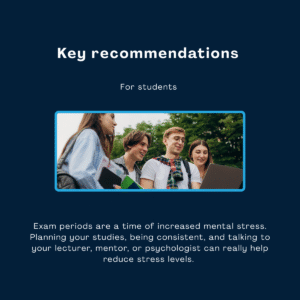
At such moments, it is crucial to restore a sense of control. Realistic study planning that accounts for attention limitations and the need for sleep, rather than assuming uninterrupted effort, helps. It is equally important to allow for breaks and regeneration, not as a luxury, but as a condition for effective learning.
The relationship and conversation between the academic teacher and the student also play an important role, especially in tutoring and mentoring. These forms of support are based on individual contact and accompanying the student in the learning process. A mentor or tutor does not solve problems for the student, but helps them to organize, name, and place them in a broader context. They show the strengths and weaknesses of the plan, which they can prepare together.
-Tutoring is mainly based on a positive relationship with the student, and supportive relationships and conversations that point the way to achieving a goal are a good remedy for improving mood,- emphasizes Dr. Karłowicz-Bodalska.
For many people, just being able to have a calm conversation with someone experienced allows them to reduce tension, regain perspective, and regain energy for life and learning.
Conversations with loved ones, family, and friends are also important. Regular social contact helps counteract feelings of loneliness and isolation, which often intensify during periods of academic overload. Emotional support, the presence of another person, and the feeling of being part of a community are important protective factors for mental health and balance in everyday functioning.
Psychological support as part of everyday academic life
An equally important element is access to psychological support, communicated regularly and without stigma. Talking to a specialist should not be treated as a last resort, but as a form of self-care during periods of increased stress.
As Dr. Karłowicz-Bodalska notes:
-Psychological support should be offered on a regular basis, regardless of the semester – practically all the time.
This approach encourages early response to overload and prevents situations in which stress builds up to a level that is difficult to control.
Exam season does not have to mean a solitary struggle
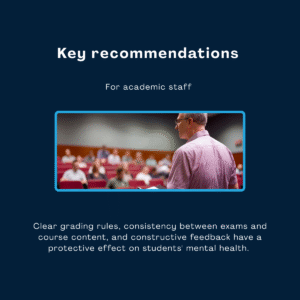
High academic standards and concern for mental well-being are not mutually exclusive. Exam season can be an intense period of study, but it does not have to be a destructive experience. When accompanied by a sensible plan, access to mentoring or tutoring, and the opportunity to discuss difficulties, tension ceases to dominate the entire study experience.
Finally, it is worth recalling a thought that sums up the essence of this approach. As Dr. Karłowicz-Bodalska says:
-What is needed is a good plan based on realistic timeframes, systematic work, and the courage to talk to a teacher who, like the student, is simply a human being. And, importantly, they see you, the students, as future employees and members of future research teams.
It is worth remembering that during the most stressful periods, the most effective antidote to stress is not isolation, but conversation and relationships.
The article on the mental health of students is based on the publication:
Quality of education and mental health of pharmacy students in Poland, Frontiers in Public Health
Advances in Clinical and Experimental Medicine
Authors: Dorota Bęben, Monika Birska, Łukasz Gądek, Dominik Marciniak, Katarzyna Karłowicz-Bodalska