

How does massage work when we look at it not through the lens of muscles, but of the brain? For years, it was associated primarily with relieving tension, reducing pain, or offering a moment of rest. Today, it is increasingly becoming the subject of neuroimaging research. Scientists are examining what exactly happens in the central nervous system during and after manual therapy.
In a review published in the Journal of Clinical Medicine, a team of researchers analysed 47 studies employing EEG, functional magnetic resonance imaging (fMRI), and functional near-infrared spectroscopy (fNIRS). The analyses included healthy individuals, patients with chronic pain, and preterm infants.
What changes in the brain?
The compiled evidence suggests that manual therapy is not merely a subjective experience. Its effects can be detected in objective neurophysiological measurements.
Depending on the assessment method, researchers observed, among other findings:
- increased alpha wave activity in EEG recordings – typically associated with a state of relaxed alertness,
- changes in beta and gamma wave activity,
- modulation of activity in brain structures involved in pain processing (including the insula and the cingulate cortex),
- alterations in the functional connectivity of networks related to stress and emotion regulation,
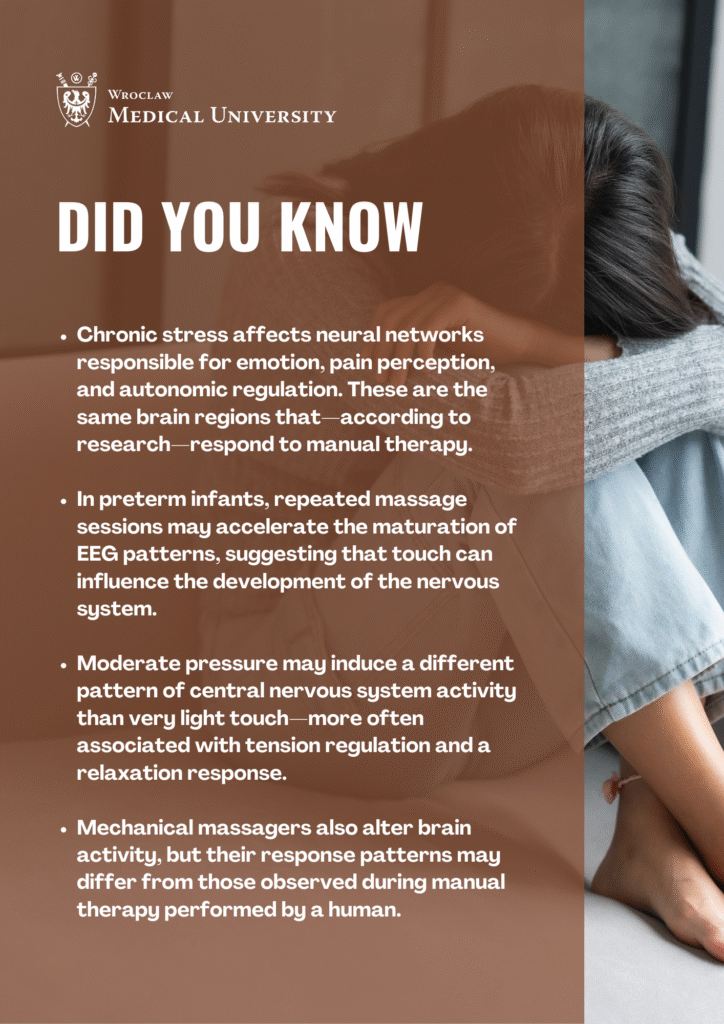
- in preterm infants – accelerated maturation of EEG patterns following repeated sessions.
As the review’s co-author, Professor Donata Kurpas of Wroclaw Medical University, emphasises:
Massage induces measurable changes in the activity and connectivity of neural networks responsible for stress regulation, pain processing, and emotional modulation. With repeated sessions, adaptive signals were also observed, which may be interpreted as potential neuroplastic processes.
Why does this matter?
Chronic stress and persistent pain are not merely sources of discomfort. They are mechanisms underlying many non-communicable diseases – from cardiovascular conditions to mental health disorders.
If massage influences neural networks involved in stress regulation and pain perception, it raises the question of its potential role within a broader context of prevention and healthcare.
Massage induces measurable changes in the activity and connectivity of neural networks responsible for stress regulation, pain processing, and emotional modulation. With repeated sessions, adaptive signals were also observed, which may be inter“Massage is not classical primary prevention,” notes Professor Kurpas, “but it may affect regulatory systems associated with stress and pain. This could also be relevant in secondary prevention and in reducing symptomatic burden. The findings justify further research; however, they do not constitute grounds for system-level recommendations.”preted as potential neuroplastic processes.
A place in primary care
Particularly compelling are the findings relating to patients with chronic pain. In some studies, changes in brain activity were accompanied by reduced pain intensity and improved wellbeing.
From a primary care perspective, massage might be considered as part of a multimodal therapeutic approach, alongside:
- physiotherapy aimed at improving function,
- psychotherapy and cognitive-behavioural interventions,
- health education and lifestyle modification.
“In primary care, massage may form part of a multimodal management strategy, particularly for patients with chronic pain and stress-related disorders. However, in my experience, it must be carefully integrated into a comprehensive therapeutic plan,” the researcher stresses.
The beginning of the journey
One of the most intriguing aspects of the review is the demonstration that massage alters the functional connectivity of neural networks associated with pain, stress, and emotion. In some studies, a series of treatments was followed by adaptive signals suggesting the possibility of longer-term regulatory changes.
However, Professor Kurpas cautions, mechanistic data are only the beginning of the journey. Neurophysiological changes are not synonymous with confirmed clinical efficacy. Well-designed clinical trials are needed, including assessments of durability of effect, safety, and cost-effectiveness. Identifying a mechanism of action does not replace clinical evidence.
From a systems perspective, studies conducted in real-world medical settings will be crucial.
Only analyses examining impacts on patients’ quality of life, medication use, and healthcare utilisation will allow us to responsibly define the place of massage within integrated care models, Professor Kurpas concludes.
Massage already holds an established place within therapeutic practice, and contemporary research is providing neurobiological explanations for its effects. When appropriately planned, it may influence central regulatory mechanisms associated with pain and stress.
This material is based on the article:
Through Massage to the Brain—Neuronal and Neuroplastic Mechanisms of Massage Based on Various Neuroimaging Techniques (EEG, fMRI, and fNIRS)
Journal of Clinical Medicine
Authors: James Chmiel, Donata Kurpas