

Stress is a constant companion in the oncologist’s office. It appears at the time of diagnosis, increases with each stage of treatment, and often does not resolve even after therapy formally ends. It accompanies therapeutic decisions, waiting for test results, fear of recurrence, and changes in daily functioning. Studies show that chronic stress can trigger biological processes that promote disease progression and weaken the body’s defenses.
This perspective is presented in a systematic review prepared by researchers from Wroclaw Medical University, published in 2026 in the International Journal of Molecular Sciences. The authors analyzed data on four cancers — breast, prostate, pancreatic, and ovarian — organizing them according to five-year survival rates.
What exactly is chronic stress?
From a biological perspective, chronic stress is a long-term strain on the body’s adaptive capacity. It is not a one-time reaction to a difficult event, but a state in which the systems responsible for responding to threats remain active for weeks or months.
In oncology, stress is multidimensional. It includes not only anxiety and sadness, but also social, professional, family, and existential factors. For many patients, it means having to redefine their life plans, social roles, and sense of control over their own bodies.
The authors of the review describe the mechanisms linking chronic stress to the course of cancer in a way that can be reduced to three related stages:
- Hormonal alarm
Chronic stress leads to persistent activation of the hypothalamic-pituitary-adrenal (HPA) axis and the sympathetic nervous system. In practice, this means a long-term increase in cortisol, adrenaline, and noradrenaline levels.
As co-author of the review, Katarzyna Herbetko emphasizes: -The body acts as if it were constantly in danger mode. This is associated with increased inflammation and immunosuppression, which can promote tumor progression and weaken the response to treatment.
- Immunity and inflammation
Stress hormones affect the immune system. Prolonged exposure to cortisol and catecholamines can weaken immune surveillance and shift the balance toward chronic, low-grade inflammation. This is an environment in which cancer cells can more easily survive, multiply, and evade control mechanisms.
- Tumor environment
At the tissue level, chronic stress can affect angiogenesis, cancer cell migration, and processes related to treatment resistance.
However, the authors consistently point out a key caveat: these mechanisms are biologically consistent with current knowledge, but in clinical trials, it is very difficult to separate the impact of stress from disease progression, treatment intensity, and other clinical factors.
Not all cancers are the same
One of the key conclusions of the review is that chronic stress does not affect all cancers equally. Its biological and clinical significance depends on both the type of disease and its prognosis.
In cancers with better survival rates, such as breast and prostate cancer, stress most often takes the form of chronic uncertainty. Patients live with the disease for a long time, struggling with fear of recurrence, side effects of treatment, and permanent changes in their quality of life. In this context, the biological role of adrenergic and glucocorticoid signaling comes to the fore, which, in preclinical studies, is associated, among other things, with metastasis and response to therapy. This does not mean that stress “undermines treatment,” but rather that, in some patients, it may be an additional biological factor contributing to the course of the disease.
A different picture emerges in cancers with a poorer prognosis, such as pancreatic and ovarian cancer. In this group, psychological distress and depression are more common and usually more severe. Importantly, psychological symptoms can sometimes precede the diagnosis of cancer, suggesting the involvement of biological mechanisms rather than just an emotional reaction to the diagnosis. At the biological level, inflammatory and cytokine mechanisms dominate, including elevated IL-6 levels and significant systemic stress.
As Katarzyna Herbetko notes, -Psychological distress is not just an emotion, but a factor that can contribute to physiological overload of the body and reduce the reserves necessary for the treatment process.
Psychotherapy – more than just conversation
The authors of the review emphasize that psychotherapy in oncology is not just emotional support. Data show that psychological interventions can:
- reduce anxiety and depression,
- improve quality of life,
- affect stress and inflammation markers, such as cortisol levels and selected cytokines.
At the same time, researchers remain cautious in their interpretation.
-There is no simple correlation: psychotherapy = longer survival. We see real, measurable biological changes, but the current state of knowledge does not allow for clear conclusions regarding mortality, – adds Katarzyna Herbetko.
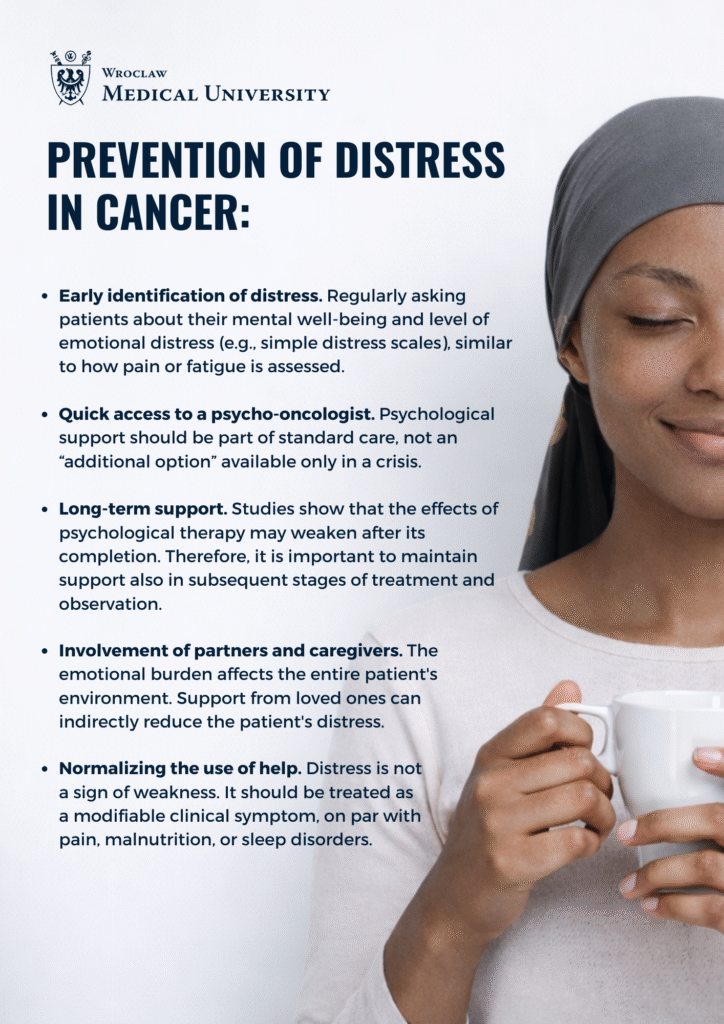
It is worth noting that the effect of psychological therapy may weaken after its completion, which indicates the need for long-term rather than episodic support.
Conclusions and recommendations
The authors clearly point out the limitations of the available data:
- heterogeneous methods of measuring stress,
- lack of meta-analyses allowing for precise quantitative conclusions,
- difficulty in separating stress as a biological factor from stress as a consequence of serious illness and treatment.
The most important message of the review is clear: chronic stress is not the patient’s fault. Rather, it is a factor associated with measurable biological processes that, like pain, malnutrition, or sleep disorders, can and should be addressed clinically.
The authors propose:
the systematic inclusion of psycho-oncology in the standard of care,
routine screening for distress and fast-track assistance,
support for partners and caregivers,
development of digital interventions (e-health) and strategies to sustain the effects of therapy.
As Katarzyna Herbetko sums up: -Psycho-oncology cannot be an add-on. Chronic stress should be treated as a modifiable risk factor in oncology, analyzed in the context of complex biological, psychological, and environmental interactions.
The material is based on the article:
The Impact of Chronic Stress on Treatment Outcomes of Cancer Patients with Divergent Survival Rates
International Journal of Molecular Sciences 2026
DOI: 10.3390/ijms27020686
Authors: Katarzyna Herbetko, Justyna Kaczor, Adam Sołtyk, Monika Kisielewska, Marcel Opęchowski, Aleksandra Sztuder, Julita Kulbacka