

Alzheimer’s disease is most commonly associated with memory impairment, disorientation, and irreversible neurodegenerative changes in the brain. We rarely think of it in the context of… a toothbrush. Meanwhile, an increasing number of studies suggest that oral inflammatory processes may be far more important for overall health, especially brain health, than previously assumed. A new study conducted by a team of researchers from the Ludwik Hirszfeld Institute of Immunology and Experimental Therapy of the Polish Academy of Sciences (IITD PAN) in Wroclaw, Wroclaw Medical University (UMW), and the University of Connecticut, USA (UConn), shows that periodontal tissue status, peripheral immune response, and cognitive functions are closely interconnected.
This is another contribution to the growing discussion on the mouth–brain axis, analogous to the well-known gut–brain axis.
From gingivitis to neurodegeneration
Periodontal inflammatory diseases are among the most common oral health problems worldwide. The mildest form—gingivitis—affects up to 90% of the adult population and is often underestimated. However, if inflammation persists, it may become chronic and lead to periodontitis, a bacterial inflammatory disease that causes permanent damage to the tissues supporting the teeth and ultimately results in tooth loss.
Periodontal inflammatory diseases have long been associated with numerous systemic conditions such as cardiovascular diseases, diabetes, and lung diseases. Increasing scientific evidence, however, indicates that they may also affect brain function and the course of Alzheimer’s disease.
What did the researchers investigate?
The study, published in 2025 in the International Journal of Molecular Sciences, included 68 participants: 36 patients with Alzheimer’s disease at varying stages of disease progression and 32 cognitively healthy individuals from the same age group. The researchers assessed:
- oral hygiene status and periodontal tissues (interdental plaque, gingival bleeding, periodontal pocket depth, clinical attachment loss),
- cognitive functions (using standardized dementia screening tests such as MMSE, MoCA, and the clock-drawing test),
- blood composition and peripheral immune markers,
- response of peripheral immune cells to lipopolysaccharide (LPS) derived from Porphyromonas gingivalis, the main etiological agent of periodontitis.
It is this last element that makes the study unique—it not only describes correlations between the two diseases but also demonstrates functional dysregulation of the peripheral immune response.
The immune paradox in Alzheimer’s disease
In patients with Alzheimer’s disease, researchers observed changes in the profile of peripheral immune cells. The most important finding was that both the overall white blood cell count and specific leukocyte subpopulations (lymphocytes, monocytes), as well as platelets, were significantly reduced compared with cognitively healthy individuals. A reduced SII marker (systemic immune-inflammation index) was also observed. These findings were considered a possible cause of the weakened immune response to bacterial antigens, indicating potential immunological deficiencies in this group of patients.
“In patients with Alzheimer’s disease, we do not observe excessive systemic inflammation, but rather certain deficits resulting from immune system weakening and exhaustion,” emphasizes Dr. Jacek Zborowski from the Department of Periodontology and Oral Pathology at Wroclaw Medical University, a co-author of the study.
A key discovery was that, under unstimulated conditions, peripheral immune cells from patients with Alzheimer’s disease produced significantly fewer pro- and anti-inflammatory cytokines than those from healthy individuals. However, after contact with a bacterial antigen, the immune response was stronger than in healthy controls.
“This is a picture of immune system dysregulation: low baseline activity (exhaustion) combined with hyperreactivity after stimulation. The immune system responds unevenly, in a potentially harmful way,”
adds the researcher.
It should be emphasized, however, that this is a more complex process in which elements of chronic inflammation and functional changes in peripheral immune cells coexist and may play different roles in the pathogenesis of Alzheimer’s disease, stresses the project leader, Dr. hab. Marta Sochocka from the Department of Immunology of Infectious Diseases and the Virology Laboratory at IITD PAN.
Gums, oral hygiene status, and memory
The most clinically interesting result concerns the relationship between periodontal tissue status and cognitive function. With the increasing severity of Alzheimer’s disease, the following indicators increased:
- interdental plaque (API),
- gingival bleeding (BOP).
Moreover, the researchers demonstrated that the greater the gingival inflammation (BOP), the lower the MMSE score, regardless of age or sex.
“This is not about advanced periodontitis. Our data suggest that even mild, chronic gingival inflammation may have systemic significance.” notes Dr. Zborowski.
The mechanism linking oral bacterial infection and inflammation to the brain
The study suggests the following scenario:
- Poor oral hygiene and chronic inflammation of periodontal tissues constitute a constant burden for the aging immune system.
- Peripheral immune cells become dysfunctional, showing both exhaustion and hyperreactivity in response to bacterial antigens.
- With age, the permeability of the blood–brain barrier to peripheral immune cells increases, along with their active participation in immunological processes within the central nervous system.
- Additional inflammatory signals and molecules may contribute to neuroinflammation.
The publication also highlights a very practical issue: people with Alzheimer’s disease take significantly less care of their oral hygiene. They brush their teeth less often, twice a day, and almost never use dental floss.
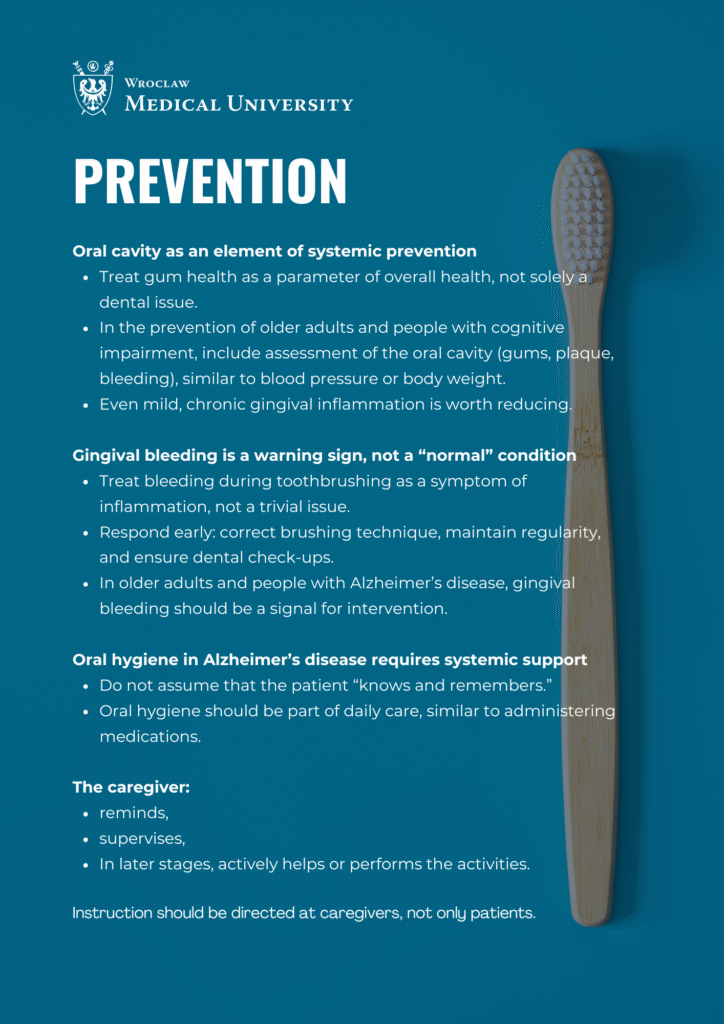
This means that dental prevention cannot rely solely on patient education. It must include caregivers and be part of systemic care.
“The state of oral hygiene in a patient with cognitive impairment is not an ‘add-on’. It is a systemic parameter that may matter for the course of the disease.”
emphasizes Dr. Zborowski.
A toothbrush as a tool for Alzheimer’s disease prevention
The authors do not announce a new therapy for Alzheimer’s disease, but their data clearly suggest that:
- the oral cavity is an active element of the immunity–brain axis,
- even mild gingival inflammation may affect the condition of peripheral immune cells,
- oral hygiene and healthy periodontal tissues should be considered part of prevention and care in patients with Alzheimer’s disease.
At a time when effective causal therapies are still lacking, priority should be given to implementing diagnostics of periodontal inflammation in individuals with cognitive impairment and dementia, especially of the Alzheimer’s type. Interventions such as regular oral hygiene may have unexpectedly significant importance in avoiding future consequences for mental health.
Source
Material based on the article:
Oral and Periodontal Health Status, Peripheral Immune Dysregulation, and Cognitive Impairment in Alzheimer’s Disease: A Clinical and Immunological Study
International Journal of Molecular Sciences
https://doi.org/10.3390/ijms262311752
Authors: Michał Ochnik, Jacek Zborowski, Jerzy Leszek, Adrianna Senczyszyn, Breno Satler Diniz, Aleksandra Sender-Janeczek, Egbert Piasecki, Marta Sochocka