

The Medical Simulation Centre of Wroclaw Medical University (UMW) will soon gain a new teaching tool—a simulator on which medical professionals will be able to learn and practice a life-saving procedure: connecting patients to ECMO. The tool is being developed through a collaboration between the university and the Lower Silesian Park of Innovation and Science S.A.
ECMO (Extracorporeal Membrane Oxygenation) is a method of extracorporeal blood oxygenation used in patients whose lungs and/or heart are unable to function on their own. The device draws blood from the body, oxygenates it and removes carbon dioxide, then pumps it back into the bloodstream. In this way, it temporarily replaces the function of these organs, giving them time to recover.
Efficient and effective ECMO cannulation requires, among other things, the ability to quickly identify the femoral vein and artery, puncture the vessel with a needle, and then precisely insert large cannulas under ultrasound guidance, dilate the vessel lumen and connect the system.
A Skill That Can Save Lives
“Connecting a patient to ECMO is not an easy procedure, and without sufficient experience it carries significant risks, including mechanical injury, infection at the catheterization site or limb ischemia,” explains Wiktor Kuliczkowski, MD, PhD, Professor at UMW, head of the Hemodynamics Laboratory at the Institute of Heart Diseases. “We use ECMO in situations where time is critical for the patient’s health and survival. One example is out-of-hospital cardiac arrest when resuscitation efforts fail. The possibility of training this skill on a professional simulator is therefore extremely valuable for us.”
The challenge is that the training equipment market offers relatively few simulators for learning ECMO cannulation.
“Above all, there is a lack of mid-range simulators that would allow comprehensive training of entire medical teams and help optimize their work. It is not only about practicing vascular puncture, but about a solution that enables simultaneous full resuscitation according to ALS standards (Advanced Life Support) with objective feedback on the quality of chest compressions and ventilation,” says Mariusz Koral, head of the Medical Simulation Centre at Wroclaw Medical University.
Until now, the university had used a simulator modified by the staff of the centre. They created an opening in the upper part of the model’s “leg” and placed a silicone insert inside it. Artificial vessels were embedded in the insert, allowing artificial blood to flow through them. This made it possible to practice ultrasound-guided puncture and catheterization, but the position of the femoral artery and vein did not fully reflect the real anatomy of the groin.
Another challenge was replicating the function of the circulatory system.
“We used an external reservoir filled with artificial fluid, which made it difficult to conduct training that reflects a closed circulation system with natural blood flow and pressure. It also affected the organization of the medical team’s work,” notes Mariusz Koral.
Technology in the Service of Healthcare
Now, thanks to an agreement between the university and the Lower Silesian Park of Innovation and Science (DPIN), two key elements will be developed: a groin module mounted to the simulator’s pelvic structure and a flexible internal “blood” reservoir that can be placed in the abdominal cavity of the simulator. Both will be produced using 3D printing technology.
This will allow trainees to practice punctures in the anatomically correct location and train access from both the left and right sides of the groin. The reservoir will ensure appropriate volume and pressure in the system, facilitate fluid refilling and help organize the training station.
“We have already completed the scanning and measurement stage of the simulator. The next steps are prototyping and testing the printed models,” explains Tomasz Ilnicki, senior 3D printing specialist at the Lower Silesian 3D Printing Centre, which is part of DPIN. “Thanks to the modular design, worn components will be replaceable, allowing the model to be used repeatedly.”
In this project, however, it is not only the 3D printing technology that matters, but above all the conceptual and design work carried out by the centre’s team, who are co-creating the solution from the ground up. At this stage, the needs expressed by university staff were translated into specific technical solutions, including the module’s design, material selection and the functionality of the entire model. As project participants emphasize, Tomasz Ilnicki is able to effectively combine the language of medicine with that of engineering, which made it possible to create a new and practical teaching tool.
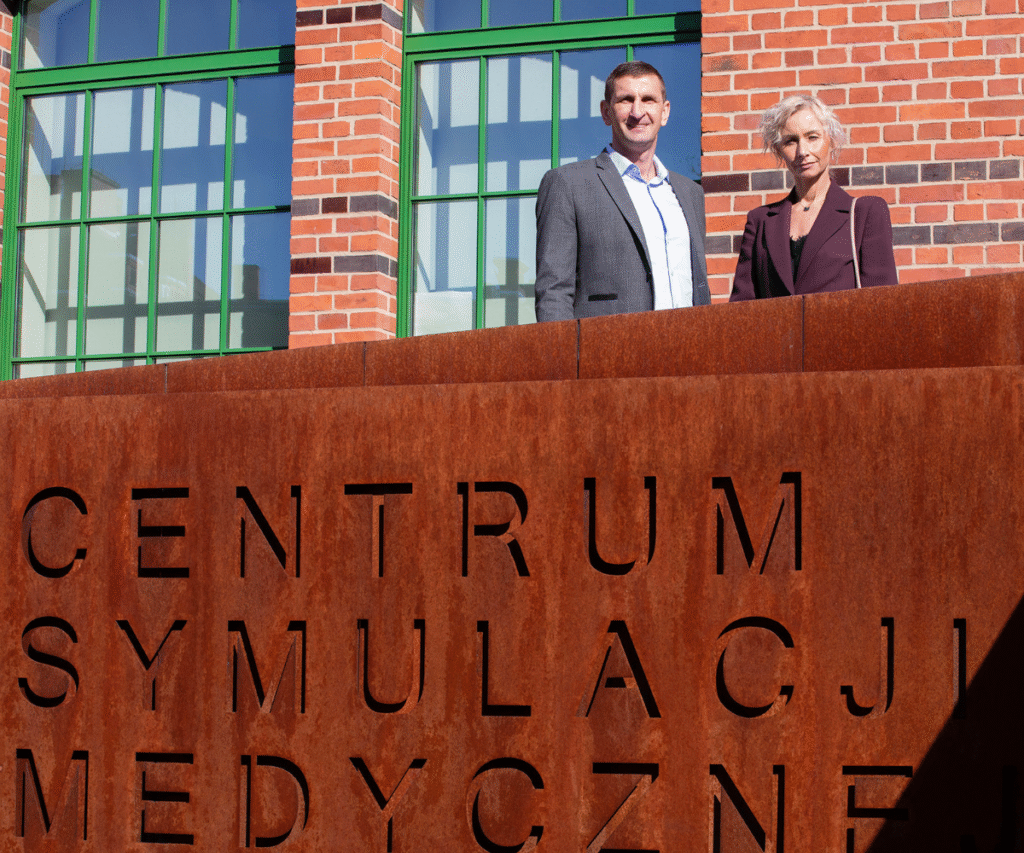
“Solutions like this are extremely important because they allow difficult procedures to be taught and practiced in safe, controlled conditions, without risk to patients,” says Robert Zymliński, MD, PhD, Professor at UMW, dean of the Faculty of Medicine and chair of the Supervisory Board of the UMW Technology Transfer Centre. “From the perspective of our faculty, it is important that innovations developed in cooperation with external partners can be used in teaching and then jointly developed and disseminated. The exceptional expertise and experience of the university’s staff and the University Clinical Hospital are fundamental to the development and implementation of such projects.”
Partnership for Doctors and Patients
If training confirms the durability and educational value of the model, the university and the company will consider introducing the solution to the commercial market. This would allow other centres to use the tool, increasing access to training in life-saving procedures.
“This project shows that our university is increasingly effective at developing lasting partnerships with business, resulting in the implementation of real solutions,” concludes Agnieszka Kowalska, PhD, Eng., coordinator of research services at the UMW Technology Transfer Centre. “It is also worth emphasizing that the project is carried out by two entities operating in the public sector, and the outcome will benefit both medical professionals and patients.”
Photo. Krzysztof Ćwik