

Kidney diseases develop slowly and may not produce any obvious symptoms for a long time. The body can compensate for them so effectively that the patient remains unaware of the problem for years. It is only in more advanced stages that symptoms appear—often nonspecific ones, such as fatigue or swelling.
This is precisely why modern nephrology increasingly focuses not only on diagnosing the disease but also on predicting its progression. And this is where artificial intelligence comes in—a tool that enables data analysis far more complex than traditional methods.
From rndividual Results to a comprehensive analysis
In conventional medicine, a doctor interprets test results based on experience and guidelines. The problem is that every patient is different, and diseases—especially chronic ones—develop in complex ways.
A team of researchers from Wroclaw Medical University analyzed the latest applications of artificial intelligence in nephrology, demonstrating that what seemed like the future just a short time ago is now beginning to transform how kidney diseases are diagnosed and treated.
As explained by Dr. Jakub Stojanowski from the Department and Clinic of Nephrology and Transplant Medicine at Wroclaw Medical University,
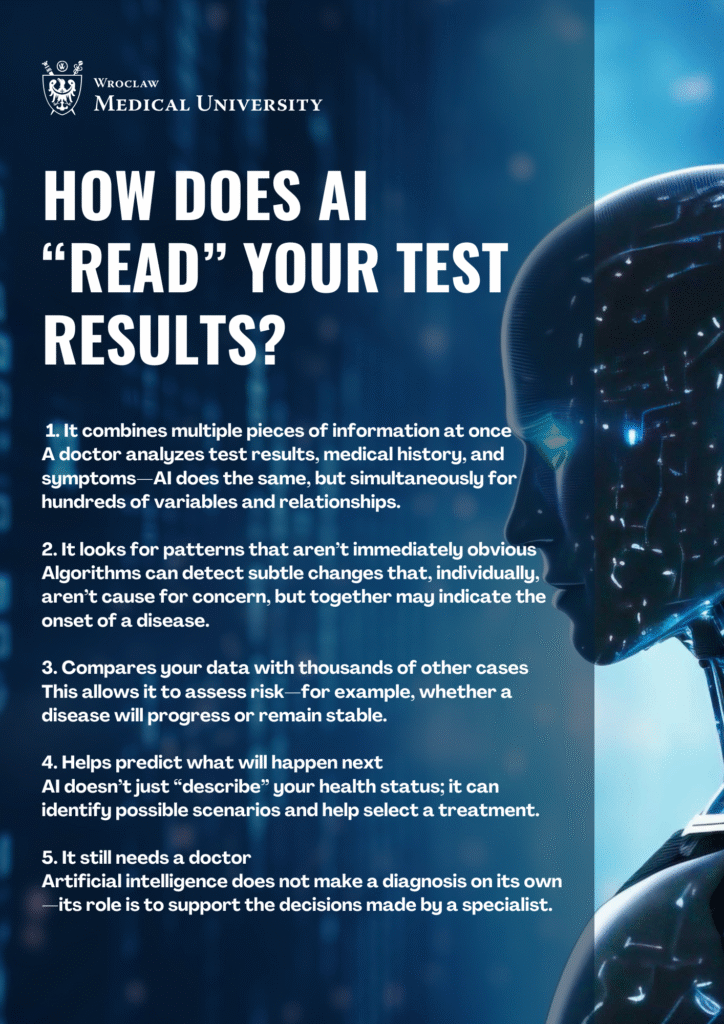
One of the key applications of artificial intelligence is its ability to integrate multiple data points simultaneously and predict their clinical significance. In practice, this means that models “define endpoints based on observational data,” for example, by helping to assess whether a particular patient’s disease will go into remission.
This approach allows us to view a disease not as a collection of individual parameters, but as a process that can be modeled and predicted.
As Dr. Jakub Stojanowski explains,
For medical data recorded in tabular form (such as test results, age, and clinical parameters), models like logistic regression, random forests, and XGBoost perform very well, as they can effectively organize information and estimate the risk of specific events.
Importantly, there are also intermediate solutions—such as the multilayer perceptron—which are simplified neural networks that combine the advantages of classical models with those of more complex methods.
In turn, the most advanced models—deep neural networks—are used when the data is more complex—for example, in medical image analysis. They can recognize structures and patterns regardless of their arrangement, which is particularly important in histopathological diagnostics.
As noted by Dr. Tomasz Gołębiowski, a professor at the university,
In practice, what matters most is whether the model helps answer a question about the patient and whether its results can inform treatment decisions. Overly complex solutions aren’t always better—sometimes they make interpretation and practical implementation more difficult.
Breakthrough: the combination of biology and artificial intelligence
The most innovative direction, however, involves combining artificial intelligence with modern biological analysis, such as proteomics or metabolomics. This approach allows for the detection of very early signs of disease—before symptoms appear or changes become visible in standard tests.
As emphasized by Prof. Kinga Musiał, Ph.D., from the Department and Clinic of Pediatric Nephrology at Wroclaw Medical University,
The greatest potential of these methods lies in their ability to analyze vast sets of biological data and identify patterns invisible in classical diagnostics. In practice, this means the possibility of earlier disease detection and better prediction of its course before irreversible kidney damage occurs.
What does this mean for patients?
For patients, the development of artificial intelligence in nephrology primarily represents a qualitative shift: diseases can be detected earlier, their progression better predicted, and treatment more tailored.
At the same time—as the authors emphasize—artificial intelligence remains a tool to support the doctor. It is the human who makes the decisions, and the technology helps them make those decisions more informed.
This material is based on the article:
Artificial Intelligence in Nephrology—State of the Art on Theoretical Background, Molecular Applications, and Clinical Interpretation
International Journal of Molecular Sciences
https://www.mdpi.com/1422-0067/27/3/1285
Authors: Jakub Stojanowski, Tomasz Gołębiowski, Kinga Musiał