

When we think about the greatest health threats, our imagination usually points to cancer, cardiovascular diseases, or new viruses that could trigger global pandemics. Meanwhile, one of medicine’s oldest adversaries remains lethally effective. Lower respiratory tract infections—primarily pneumonia and bronchiolitis—continue to be the leading infectious cause of death worldwide.
The latest Global Burden of Disease 2023 analysis, published in The Lancet Infectious Diseases and co-authored by Mieszko Więckiewicz, Head of the Department of Experimental Dentistry at Wroclaw Medical University, reveals the scale of the problem with brutal precision. In 2023, lower respiratory tract infections were responsible for approximately 2.5 million deaths and nearly 99 million years of life lost due to premature death or disability. These figures are so large that they are difficult to fully comprehend.
The two highest-risk groups
Over the past decades, the world has made significant progress. Among children under five years of age, mortality from these infections has decreased by one-third since 2010. This must be stated clearly—it is the result of vaccination, improved medical care, better diagnostics, and greater access to treatment. Medicine is now more effective at saving patients from pneumonia than ever before.
However, this is precisely where the most important “however” emerges. Progress does not mean the problem has been solved. The global target set by World Health Organization and UNICEF for children under five has still not been achieved. In 2023, the mortality rate in this group remained significantly higher than expected. This means that despite improvements, hundreds of thousands of children continue to die from causes that are, in many cases, preventable.
The study shows that pneumonia today is a disease of two extremes of age. The greatest burden falls not only on young children but also on individuals over the age of seventy. This represents an important shift in perspective. For years, the global narrative around respiratory infections focused primarily on the youngest. However, an aging world is increasingly revealing the second face of the problem. The bodies of older individuals cope less effectively with infection, comorbidities are more common, and recovery is often more difficult and prolonged. As a result, it is seniors who now have the highest mortality rates from lower respiratory tract infections.
“For Poland, this means moving away from a model focused solely on pediatrics and adopting a strategy that simultaneously targets children and older adults,” emphasizes Professor Więckiewicz. “The priority should be population-wide prevention throughout the entire life course, not only the treatment of acute episodes.”
Vaccination—The greatest success and still an underused opportunity
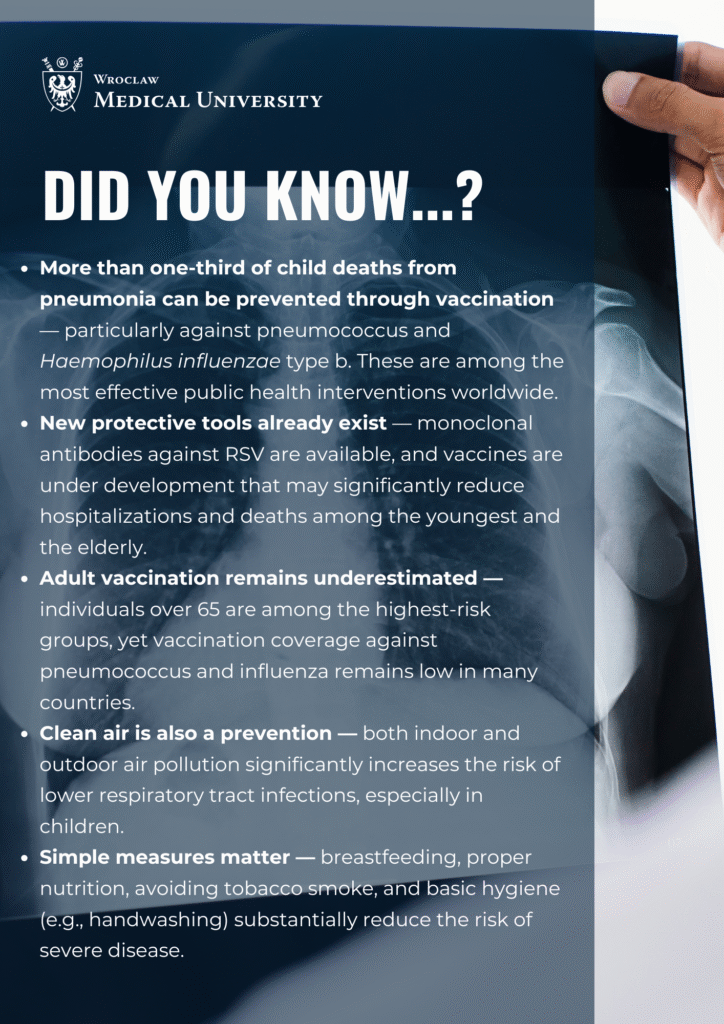
Vaccination is one of the most important protagonists of this story. It is largely responsible for the reduction in child deaths, particularly through protection against pneumococcus and Haemophilus influenzae type b. New strategies for protection against RSV are also raising increasing hopes, including monoclonal antibodies and vaccines.
The problem, however, is that access to these tools is unequal. In low-income countries—where the disease burden is highest—modern preventive measures are introduced the slowest.
A similar situation applies to adult vaccination. Although older adults are among the highest-risk groups, vaccination programs against pneumococcus and influenza remain insufficient in many regions. Experts indicate that a transition from a passive to an active model is necessary—one that includes automatic reminders in e-health systems, vaccination status assessment during routine visits, and broader vaccination reimbursement for individuals aged 65 and over.
What causes pneumonia
At the center of this narrative remains a well-known culprit: Streptococcus pneumoniae, commonly known as pneumococcus. It accounts for the highest number of deaths associated with these infections worldwide. It is followed by Staphylococcus aureus and Klebsiella pneumoniae.
At the same time, the study broadens the perspective. Researchers included 26 pathogen groups, 11 of which were modeled for the first time. This provides a clearer understanding that the picture of lung infections is more complex than suggested by the traditional textbook list of culprits. Increasingly significant are, for example, non-tuberculous mycobacteria and fungi of the genus Aspergillus. These are not pathogens that the general public typically associates with pneumonia—yet they contribute to the global burden of deaths.
A biological disease, but also a social one
The authors also highlight the stark geography of inequality. The highest mortality rates persist in countries of sub-Saharan Africa. It is there that pneumonia is most clearly seen not merely as a biological problem, but also as a disease of poverty—limited access to healthcare, insufficient vaccination programs, restricted diagnostics, and delayed treatment.
In wealthier countries, pneumonia may be a severe medical episode. In poorer regions of the world, it still remains a death sentence for many children.
We know what works
The study provides not only a warning but also a relatively clear roadmap for action. We know what works: vaccination against pneumococcus and Hib, development of RSV protection, improved care for children with dyspnea and fever, earlier detection of infections in older adults, and more effective adult vaccination programs.
The issue, therefore, is not a lack of knowledge. The issue is that this knowledge is not implemented evenly.
“The most important actions should focus on education, vaccination, and early diagnosis. Health education should be treated as an equal pillar of prevention, alongside vaccination and diagnostics,” says Professor Więckiewicz.
As the researcher emphasizes, in primary healthcare, a brief, mandatory educational intervention during visits involving children and older adults could yield significant benefits. This should include hand hygiene, proper coughing and sneezing practices, limiting transmission in households and care facilities, and recognizing warning signs such as dyspnea or decreased oxygen saturation.
Experts also point to the importance of simple diagnostic tools. Pulse oximetry—a rapid, non-invasive measurement of oxygen saturation—could become a standard for both children and older adults with suspected lower respiratory tract infections.
This may be the most important conclusion of the entire study. In the fight against lower respiratory tract infections, the world is no longer at square one. We know how to prevent some deaths. We know how to treat more effectively than before. We are increasingly accurate in identifying causative agents. And yet, we continue to lose sight of where medicine ends—at the boundaries of access or where distrust, fueled by medical misinformation, takes hold.
Pneumonia is therefore not a relic of the past. It is a disease that follows global inequalities and population aging. If it is to be removed from the ranks of the leading infectious killers, further laboratory discoveries will not suffice. Vaccines, diagnostics, and physicians are needed. Equally necessary are consistent health education and systems for monitoring outcomes—from vaccination coverage to 30-day mortality.
This material is based on the article:
DOI: 10.1016/S1473-3099(25)00689-9
Authors: Mieszko Więckiewicz