

Scientists from Wrocław discover a new principle governing one of the nervous system’s most important receptors
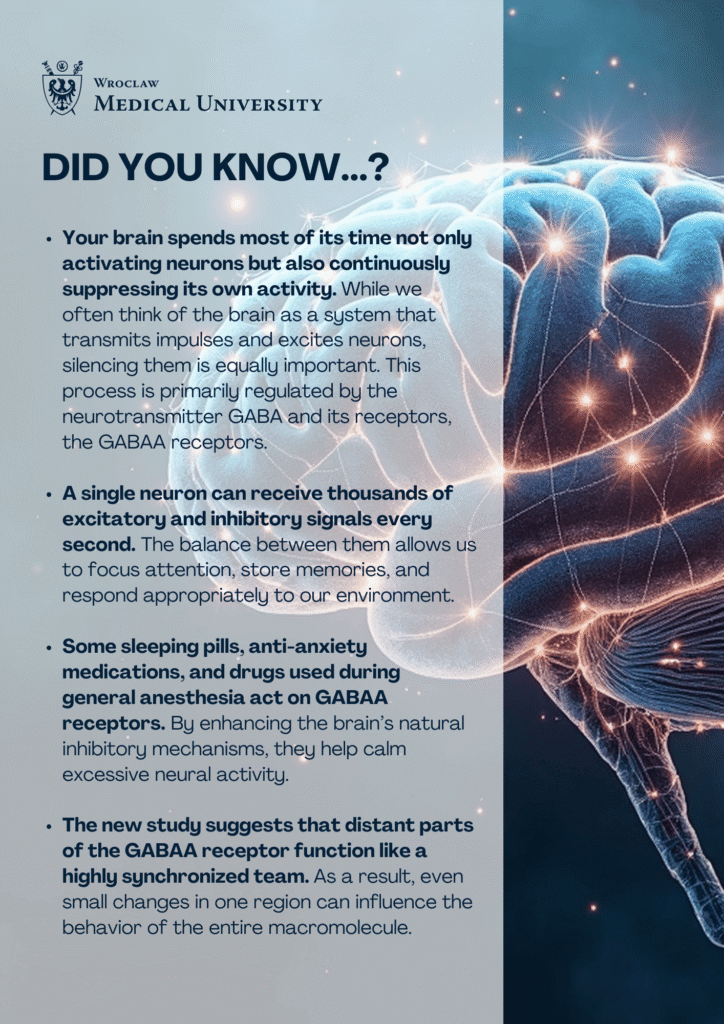
Memory, concentration, sleep, emotions, and even the risk of epilepsy or anxiety disorders all depend on a delicate balance between excitation and inhibition in the brain. A key role in maintaining this balance is played by GABAA receptors – molecular “brakes” that protect neuronal networks from excessive activity.
A team of researchers, including scientists from Wroclaw Medical University, has discovered that this receptor operates in a much more coordinated manner than previously thought. The findings, published in PNAS, may help improve our understanding of how drugs used to treat anxiety, insomnia, and epilepsy work. The study has also received recognition from the scientific community, earning distinction in the prestigious Jerzy Konorski Award competition, which honors the best Polish research papers in neurobiology.
Brakes, without which the brain could not function
Although most neurons in the brain transmit excitatory signals, it is often the inhibitory system that determines when and how strongly neurons become active.
An increasingly dominant view is that GABAergic inhibition plays the leading role in controlling the activity of neuronal networks in the brain, – says Prof. Jerzy Mozrzymas from the Department of Biophysics and Neurobiology at Wroclaw Medical University. -Inhibitory synapses have access to the most strategic parts of the neuron, where the decision to generate a nerve impulse is made. They are also essential for producing brain rhythms associated with memory, attention, and other higher cognitive functions.
Research over recent years has also shown that disturbances in the GABAergic system may play an important role in the development of epilepsy, anxiety disorders, schizophrenia, and autism spectrum disorders.
An increasingly dominant view is that GABAergic inhibition plays the leading role in controlling the activity of neuronal networks in the brain, – says Prof. JeMore and more evidence indicates that dysfunction of GABAergic transmission lies at the core of many neurological and psychiatric conditions. This is why GABAA receptors are now among the most important research targets in modern neurobiology, – Prof. Mozrzymas emphasizes.rzy Mozrzymas from the Department of Biophysics and Neurobiology at Wroclaw Medical University. -Inhibitory synapses have access to the most strategic parts of the neuron, where the decision to generate a nerve impulse is made. They are also essential for producing brain rhythms associated with memory, attention, and other higher cognitive functions.
The GABAA receptor functions like a specialized gate embedded in a neuron’s cell membrane. When the neurotransmitter GABA binds to it, the channel opens, allowing ions to flow and reducing the nerve cell’s activity. The researchers set out to investigate exactly how this process unfolds at the level of the receptor’s individual structural elements.
We demonstrated that the first stage of receptor activation, neurotransmitter binding, is a local process involving the binding sites and their immediate surroundings. Channel opening is different. It is a global process that requires the cooperation of many structural elements of the receptor, often located far apart from one another,- explains Dr. Michał Michałowski from the Department of Biophysics and Neurobiology at Wroclaw Medical University.
The discovery led the authors to formulate a new principle describing receptor function: “binding is local, gating is global.”
How can the movements of a single protein be observed?
To investigate the receptor’s mechanism of action, the scientists used an advanced technique, Φ-value analysis, which is used to study protein function.
Φ-value analysis allows us to look ‘inside’ the channel-opening process and determine which parts of the receptor change earlier and which later. This enables us to reconstruct something like a movie showing how a wave of conformational changes travels through the entire protein structure, – says Dr. Michałowski.
The results proved surprising. Rather than observing a clear sequence of consecutive changes, the researchers found that many distant parts of the receptor acted almost simultaneously.
Very different receptor regions, often far apart from one another, move almost in unison rather than in a step-by-step sequence. This means that the receptor functions as an exceptionally integrated unit, and its activation is much more coordinated than previously assumed,- the researcher explains.
Why does this matter for medicine?
GABAA receptors are among the most important targets in modern pharmacology. They are affected by benzodiazepines used to treat anxiety disorders, as well as sedatives, hypnotics, antiepileptic drugs, agents used during general anesthesia, and modern neurosteroids employed in the treatment of postpartum depression.
The new findings suggest that the receptor’s remarkable sensitivity to such a wide variety of substances may stem precisely from its globally coordinated structure and mode of operation.
Just as mutations in very different regions of the receptor can dramatically alter its function, drugs acting at different binding sites can also produce powerful modulatory effects. Understanding the fundamental principles that define the relationship between the structure and function of the GABAA receptor may be crucial for designing new modulators with clinical significance, – says Prof. Jerzy Mozrzymas.
Although this is a basic science discovery, it may eventually help researchers develop drugs that act more precisely and selectively, improving their effectiveness while reducing the risk of side effects.
Read more
This article is based on:
https://pmc.ncbi.nlm.nih.gov/articles/PMC12478134
Authors: Michał Michałowski, Katarzyna Terejko, Michalina Gos, Ilona Iżykowska, Marta Czyżewska, Karol Kłopotowski, Przemysław Kaczor, Aleksandra Brzóstowicz, Estera Płużek, Monika Migdałek, Jerzy Mozrzymas
Φ value analysis underscores strong functional and structural compactness of the GABAA receptor