

Heart failure already affects more than 60 million people worldwide and is one of the leading causes of hospitalization among people over the age of 65. Although it is commonly associated with advanced cardiovascular disease, it actually develops over many years, often without symptoms. Authors of a new expert statement published in the European Heart Journal argue that this is precisely why prevention may become the most effective weapon in tackling one of the greatest challenges of modern medicine.
This is the first comprehensive document devoted exclusively to the prevention of heart failure. The experts summarize current knowledge on risk factors, effective preventive measures, and methods for identifying individuals at particularly high risk of developing the condition.
A disease that begins much earlier
Heart failure is not a single disease but a syndrome resulting from the heart’s inability to pump blood effectively. It is most often the final stage of long-term pathological processes associated with hypertension, diabetes, obesity, coronary artery disease, chronic kidney disease, or atrial fibrillation.
The problem is becoming increasingly serious. Population ageing, sedentary lifestyles, and the growing prevalence of metabolic diseases are causing the number of patients with heart failure to rise steadily around the world.
Heart failure is one of the most common complications of cardiovascular diseases and remains a major cause of hospitalization and premature mortality. Population ageing and the increasing prevalence of obesity, diabetes, and hypertension mean that the number of patients continues to grow. Therefore, preventive measures are now of key importance both for patients’ health and for the sustainability of healthcare systems, – emphasizes Prof. Izabella Uchmanowicz from the Department of Nursing, Faculty of Nursing and Midwifery, Wroclaw Medical University.
Prevention instead of treating the consequences
Until recently, efforts related to heart failure focused primarily on treating patients who had already developed the disease. The authors of the statement indicate that the future lies in prevention and the early identification of individuals at risk.
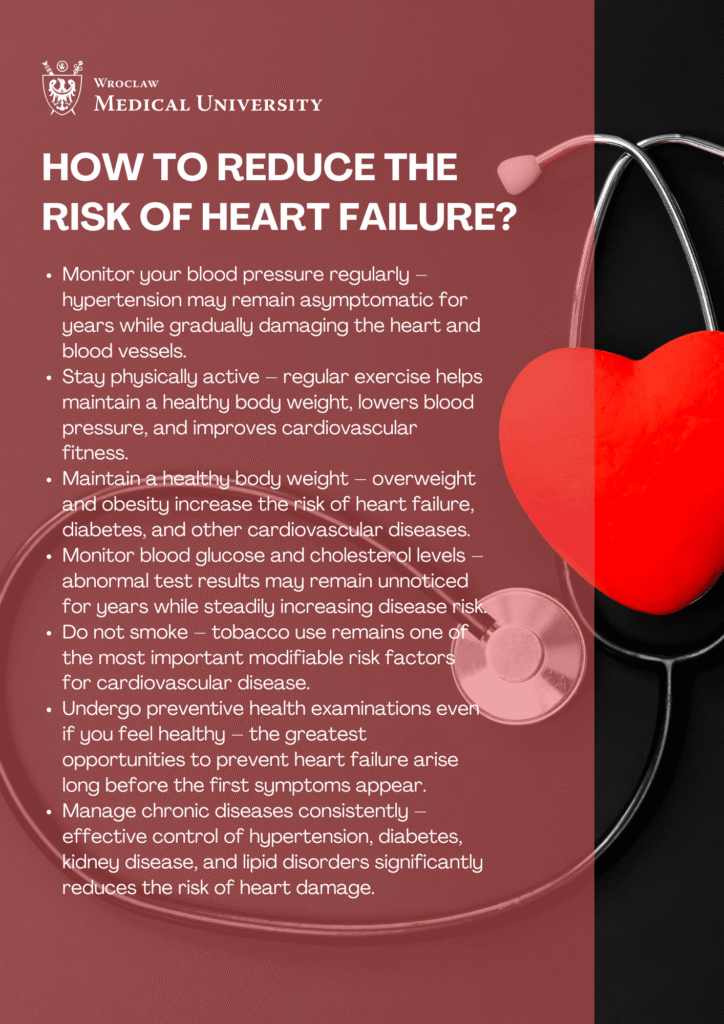
Modifiable risk factors play a crucial role. Regular physical activity, a healthy diet, maintaining a healthy body weight, avoiding tobacco use, and limiting alcohol consumption can significantly reduce the likelihood of developing heart failure. Equally important is the effective treatment of hypertension, diabetes, lipid disorders, and chronic kidney disease.
The greatest impact comes from measures aimed at modifying risk factors: regular physical activity, a healthy diet, maintaining a healthy body weight, and avoiding tobacco use. Growing evidence also highlights the importance of individualized prevention strategies and the early implementation of effective therapies in high-risk individuals, – says Prof. Uchmanowicz.
The authors point out that modern prevention is no longer limited to lifestyle recommendations. Increasing hopes are also being placed in novel pharmacological therapies that may protect the heart even before the first symptoms of heart failure appear. This is particularly relevant for people with type 2 diabetes and chronic kidney disease, who belong to the groups at highest risk of developing the condition.
Heart failure does not begin in a cardiologist’s office
For many years, the body can effectively compensate for the effects of hypertension, diabetes, or obesity. Patients continue to function normally and experience neither pain nor shortness of breath, so they rarely perceive themselves as being at risk of heart disease. Yet it is during this period that the processes leading to heart failure may already be underway.
This is why so much depends on the family physician. Unlike specialists who may see a patient for a limited period, primary care physicians often follow patients for decades. They observe changes in body weight, blood pressure, laboratory results, and the management of chronic conditions.
Primary healthcare plays a crucial role because family physicians are usually the first to identify and monitor over time the risk factors that lead to heart failure, including hypertension, diabetes, obesity, lipid disorders, and chronic kidney disease, – says Prof. Donata Kurpas from the Department of Nursing, Faculty of Nursing and Midwifery, Wroclaw Medical University.
Prevention, however, is not limited to prescriptions and additional tests. It often begins with a conversation about everyday habits: physical activity, sleep, nutrition, and stress. These seemingly ordinary aspects of life may determine whether the heart remains healthy for years to come.
The best time to act? Before symptoms appear
One of the most interesting observations presented in the statement concerns the stage at which prevention brings the greatest benefits. It is not during advanced disease, nor even when the first symptoms appear. The greatest opportunities arise much earlier—when a person still feels healthy.
This is why experts emphasize health education for people who have not yet reached cardiology clinics. Hypertension, excess weight, and sedentary lifestyles may not produce obvious warning signs for years, yet they consistently increase the risk of future heart problems.
It is particularly important to educate people who feel healthy but already have risk factors, because that is when we can make the greatest difference. From the perspective of integrated care, heart failure prevention should not begin only in a cardiology clinic but much earlier—in primary care, through health education, within local communities, and through everyday decisions that support heart health throughout life, – emphasizes Prof. Kurpas.
This approach is also reflected in the “Keep Your Pressure Under Control” campaign conducted by Wroclaw Medical University. Its goal is to raise awareness of a problem that may remain unnoticed for years. Hypertension does not cause pain, yet it remains one of the most important contributors to cardiovascular disease.
Modern medicine is becoming increasingly effective at identifying individuals at particularly high risk of developing heart failure. However, even the most advanced technologies do not change one fundamental fact: heart health is built every day—at the dining table, during a walk, in the family physician’s office, and through routine examinations performed long before any symptoms become apparent.
Read more
Material based on the article:
Prevention of heart failure | European Heart Journal | Oxford Academic
Authors: Massimo Piepoli, Giuseppe Rosano, Ana Abreu, Marianna Adamo, Andrea Attanasio, Ovidiu Chioncel, Alain Cohen-Solal, Gerasimos Filippatos, Eva Gerdts, Andreas Gevaert, Martin Halle, Pardeep Jhund, Donata Kurpas, Brenda Moura, Gianfranco Parati, Mark C. Petrie, Eduard Shantsila, Maggie Simpson, Isabella Sudano, Maryia Tokmakova, Daniela Tomasoni, Izabella Uchmanowicz, Maurizio Volterrani, Marco Metra
European Heart Journal