

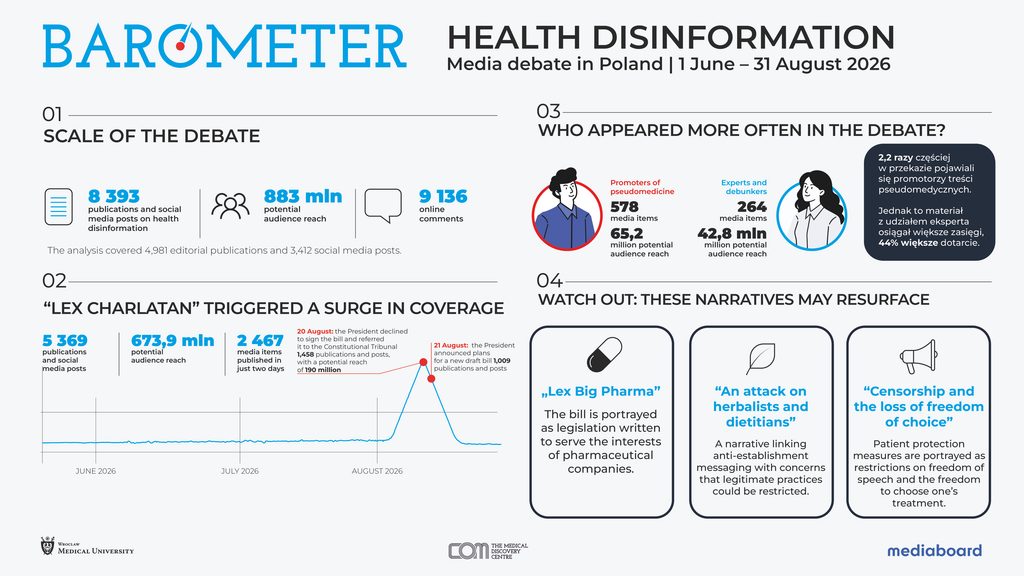
Nearly 2,500 publications with a potential reach of 190 million contacts in just two days. The Medical Misinformation Barometer, developed by Wroclaw Medical University (WMU) and Mediaboard, examines the media response to the “lex szarlatan” bill as the key issue of the past quarter. This is the first in a series of regular reports prepared by the WMU Medical Misinformation Observatory. It not only describes the main narratives circulating in the public debate but also identifies potential sources of emerging crises.
Medical misinformation is no longer a topic confined to specialist media. The latest quarter, analysed in the Medical Misinformation Barometer, shows that the debate surrounding legislation on pseudomedical practices has moved beyond the issue of patient safety. It has become intertwined with politics, freedom of speech, “censorship”, “Big Pharma” and alleged threats to herbalists and dietitians. A medical issue has thus become part of a broader political and ideological conflict. And as a conflict, it has attracted significant media attention.
Systemic action is needed: WMU Medical Misinformation Observatory
“The medical community alone is no longer enough to counter misinformation effectively. Cross-sectoral cooperation is essential, and above all, we need systemic action. Declarations, one-off campaigns or events will not produce measurable results. This is why we established the Centre for Medical Discovery at Wroclaw Medical University, within which we are now developing the Medical Misinformation Observatory,” explains Prof. Piotr Ponikowski, Rector of WMU.
“We are moving away from general statements and assumptions. Instead, we rely on analyses, narratives and figures that describe a specific moment in time. We track reality almost in real time, which allows us to better understand its dynamics and prepare measures that may help prevent new flashpoints. The Observatory is part of WMU’s broader system of activities aimed at strengthening the country’s information resilience. These include science communication, a free health education textbook, AI tools supporting teachers, teacher training and a portal verifying popular medical myths,” Prof. Ponikowski adds.
“Lex szarlatan” triggered an avalanche
The first quarterly Barometer shows how the debate changes in response to current events. Between June and the end of August, 8,393 publications and posts concerning health misinformation were identified. Together, they generated 883 million potential contacts with the content. The analysis also covered 9,136 online comments.
The most prominent topic of the quarter was the controversy surrounding the bill commonly referred to as “lex szarlatan”. It accounted for 64% of all publications and posts and 76% of the total reach of the analysed debate. Over the three-month period, 5,369 items concerning the bill were published, generating nearly 674 million potential contacts and more than 5,000 comments.
A turning point came on 20 August, when the President decided not to sign the bill and referred it to the Constitutional Tribunal. On that day alone, 1,458 publications and posts appeared, generating 190 million contacts. The following day, after the announcement of a presidential legislative proposal, another 1,009 items were recorded. In just two days, 2,467 publications and posts appeared.
“In my view, expanding the powers of the Commissioner for Patients’ Rights is a step in the right direction. Of course, there is room for discussion about the scope of these powers and the definitions of pseudomedical practices or medical misinformation. However, it is worth emphasising that the powers that were to be granted to the Commissioner for Patients’ Rights are not new to the Polish legal system. According to the explanatory memorandum accompanying the ‘lex szarlatan’ bill, they were modelled on the powers already held by the President of the Office of Competition and Consumer Protection in matters concerning consumer protection,” explains Dominika Szachniewicz, attorney-at-law and Director General of WMU.
“If, as consumers, we benefit from comprehensive protection, why should we be concerned about similar protection when our life or health is at stake and the consequences of certain actions may be irreversible? Today, there is no system for warning patients about medical misinformation or pseudomedical practices. A system based on penalties alone is therefore not enough. As patients, we need a legitimate source of information, for example a register of entities disseminating medical misinformation. Protecting our life and health must take priority when confronted with dishonest commercial practices,” Dominika Szachniewicz adds.
Misinformation “recycles” old narratives
The Barometer shows that false narratives do not disappear when the event that triggered them comes to an end. They remain in the information environment and can quickly be reused during another controversy, crisis or political decision.
“‘Lex szarlatan’ demonstrated how easily existing narratives can be attached to a new event. ‘Big Pharma’ becomes ‘lex Big Pharma’, while earlier claims about the censorship of inconvenient knowledge become arguments against regulations concerning pseudomedical practices,” explains Wioletta Samborska, Director of the WMU Centre for Medical Discovery.
“Misinformation does not start from scratch. It has a library of ready-made narratives that can be activated when another favourable event occurs,” she adds.
On the brink of new crises
The Barometer identifies not only individual topics but also narrative patterns that may be reused in the future. Three particularly prominent narratives emerged around “lex szarlatan”: claims that the bill had been written at the behest of pharmaceutical companies, that it would harm herbalists and dietitians, and that it would lead to censorship and deprive patients of freedom of choice.
The “Lex Big Pharma” narrative appeared in 226 items and 304 comments. Almost as frequently, in 227 items, claims were made that the legislation would threaten the legal activities of herbalists, dietitians and practitioners of natural medicine. This narrative proved particularly significant because it combined anti-establishment messaging with a more widespread concern about restrictions on lawful practices.
In 56 items, the bill was portrayed as a tool of censorship and a means of restricting freedom. A significant risk of further medical misinformation is also associated with AI-generated images of doctors and high-profile court cases involving celebrities who disseminate anti-scientific content.
The voice of science is heard, but not often enough
Experts explaining and correcting misinformation appeared in the media 264 times during the analysed period. Promoters of pseudoscience appeared 578 times. Interestingly, expert content achieved a significantly greater reach. Why? Because it appeared in media outlets with much larger audiences.
This suggests that a well-planned expert presence in the media can effectively counterbalance pseudoscientific messaging, provided that it is not limited to journalistic content itself but also extends to the comments appearing beneath it.
Misinformation thrives in the comments
False or misleading content accounted for 7% of the analysed publications and posts, but its share rose to 12% in comments. A total of 9,136 comments were included in the analysis.
This difference is important because it demonstrates that a reliable journalistic article or expert statement does not end the circulation of information. A second information stream can emerge beneath a publication, including counterarguments, conspiracy theories, personal testimonies and attempts to undermine the credibility of doctors.
“The figures in our report speak for themselves, but it is worth explaining what lies behind them. We monitor the media and rarely see a health-related topic generate nearly 2,500 publications in just two days. Of course, this does not include unexpected or crisis events such as the COVID-19 pandemic. It shows that medical misinformation is no longer a niche phenomenon. It clearly thrives wherever there is emotion, conflict and a fast-moving news cycle,” says Marcin Szczupak, CEO of Mediaboard Polska.
“For us, as a company specialising in media monitoring and analytics, the key conclusion is that it is not enough to look at what a newsroom publishes. We also need to pay attention to what happens afterwards in comments and on social media, in this second, informal circulation of information. This is where false content grows fastest.
We are pleased to have supported Wroclaw Medical University by providing data for this report. We believe that regularly demonstrating the scale of the phenomenon through figures rather than assumptions is the first step towards responding to it effectively,” adds the CEO of Mediaboard Polska.
Detailed analyses and the study methodology are available in the Medical Misinformation Barometer on the Wroclaw Medical University website: