

Mulberry has long been used as both food and traditional medicine. Today, scientists are investigating whether its compounds can influence the gut microbiota and, through it, metabolism. A review involving researchers from Wroclaw Medical University shows that the mulberry species, the plant part used, and the processing method may all matter for these effects.
The gut microbiota not only contributes to the functioning of the gastrointestinal tract but may also influence metabolism throughout the body. Mulberry is particularly interesting in this respect because it contains numerous bioactive compounds, including polyphenols and polysaccharides, which may interact with gut microorganisms, explains Anna Prescha, PhD, DSc, Professor at Wroclaw Medical University, from the Department of Dietetics and Bromatology.
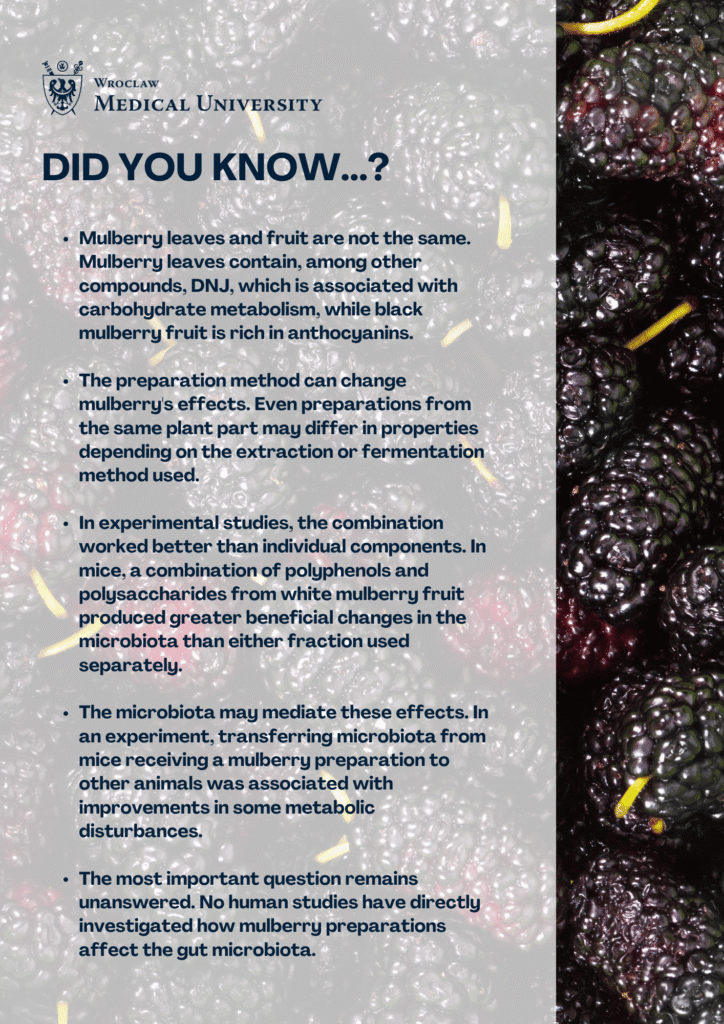
Most studies have focused on white mulberry (Morus alba), but black mulberry (Morus nigra), particularly its fruit, has also provided interesting findings. Mulberry leaves contain, among other compounds, 1-deoxynojirimycin (DNJ), known for its effects on carbohydrate metabolism, as well as polyphenols and polysaccharides. The fruit, especially that of black mulberry, is rich in anthocyanins and other phenolic compounds and also contains polysaccharides. The way the raw material is prepared is also important. Drying, fermentation, or the type of extraction can alter the content and proportions of bioactive compounds, meaning preparations from the same material may differ in composition and effects.
Mulberry and gut microbiota: what do studies show?
The review indicates that preparations made from both mulberry leaves and fruit may influence the composition and activity of the gut microbiota. Studies have reported, among other effects, changes in the abundance of beneficial bacteria and increased production of short-chain fatty acids such as acetate, propionate, and butyrate. Gut bacteria produce these compounds when they ferment dietary components, and they play an important role in intestinal function. Some studies also linked changes in the microbiota to improvements in parameters related to glucose and lipid metabolism.
Importantly, however, the effects varied depending on the material studied and how it was prepared. Polysaccharides from black mulberry fruit provide a good example. Different extraction methods produced fractions that differed in structure and in the extent to which gut microbiota utilized them. Fractions obtained through water extraction and with pectate lyase showed the highest prebiotic potential. Studies of leaf polysaccharides, in turn, showed that their structure, including molecular weight and monosaccharide composition, may influence which bacteria use them as a substrate and which short-chain fatty acids are produced.
Particularly interesting findings came from studies of more complex preparations. In a model involving mice fed a high-fat diet, a fraction containing both polyphenols and polysaccharides from white mulberry fruit produced greater beneficial changes in the microbiota than the individual fractions administered separately. This was accompanied by improvements in some parameters related to metabolic syndrome and intestinal health. The researchers also conducted a microbiota transplantation experiment in the same model. Transferring microbiota from mice receiving the combined fraction to other animals also improved some metabolic disturbances, providing further evidence that the microbiota may mediate the preparation’s effects.
These findings suggest that what matters is not only the presence of an individual compound, but also the complex composition of the preparation, the proportions of its compounds, and their interactions. Therefore, rather than searching for a single universal product, it is worth determining which combination of species, plant part, composition, and processing method produces a specific biological effect, emphasizes Prof. Anna Prescha.
The idea originated in a student research group
The idea to investigate the relationship between mulberry and the gut microbiota originated in the Nutri-Sfera Student Research Group at the Department of Dietetics and Bromatology at Wroclaw Medical University. Two students, now graduates, proposed the topic: Marta Miszczak from the Dietetics program and Karolina Kłosowska-Buryło from the Pharmacy program. The project therefore brought together nutritional and pharmaceutical perspectives.
This fitted very well with the interdisciplinary nature of the study. It combined a perspective on mulberry as a plant material with a specific composition with an analysis of its potential effects on the microbiota and metabolism, adds Prof. Prescha.
Studies involving humans are needed
The most important limitation of the current evidence is the lack of human studies that directly assess the effects of mulberry preparations on the gut microbiota. The available data come primarily from animal models and in vitro studies. Comparisons between studies are further complicated because only a small number link the observed effects to a detailed analysis of the composition of the preparation used.
The available findings are promising, but at this stage they do not allow us to determine whether the relationships observed in experimental models between mulberry preparations, the microbiota, and metabolism also occur in humans, Prof. Prescha points out.
Clinical studies using thoroughly characterized and standardized preparations are therefore needed. Only then will it be possible to determine how different mulberry products affect the human gut microbiota, how the range and magnitude of these effects differ, and whether they translate into measurable health benefits.
Publication
M. M. Miszczak, K. Kłosowska-Buryło, J. M. Pieczyńska, M. Bielecka, A. Prescha,
Mulberry, Gut Microbiota and Gut Functionality: Effects Shaped by Raw Material and Processing Methods, Biomolecules 2026, 16(7), 965. Mulberry, Gut Microbiota and Gut Functionality: Effects Shaped by Raw Material and Processing Methods | MDPI