

More than half of children diagnosed with symptomatic type 1 diabetes in Poland between 2019 and 2022 already had diabetic ketoacidosis at the time of diagnosis. A nationwide study covering almost the entire pediatric population shows that the problem worsened during the COVID-19 pandemic. Still, even after the pandemic, the frequency of this serious complication did not return to its previous level. One of the study’s co-authors is Agnieszka Zubkiewicz-Kucharska, MD, PhD, from Wroclaw Medical University.
The researchers analyzed cases of newly diagnosed type 1 diabetes in children and adolescents in Poland between 2019 and 2022. The final analysis included 6,543 individuals under 18. Of these, 54.5% already had diabetic ketoacidosis at the time their diabetes was diagnosed.
Diabetic ketoacidosis is a serious, potentially life-threatening complication of insulin deficiency. It involves a significant increase in blood glucose levels, ketone production, and metabolic acidosis. If left untreated, ketoacidosis can lead to impaired consciousness, cerebral edema, and, in the most severe cases, death.
The pandemic exacerbated the problem
In 2019, diabetic ketoacidosis was diagnosed in 47.9% of children with newly diagnosed symptomatic type 1 diabetes. In 2020, this figure rose to 58.6%. By 2022, it had fallen to 54%, but remained higher than before the pandemic.
Statistical analysis also allowed researchers to estimate the scale of the pandemic’s impact. During this period, ketoacidosis was diagnosed in 56.8% of children, compared with the 47.5% predicted based on previous trends. This represents a difference of approximately 9.4 percentage points. Moderate or severe ketoacidosis was also diagnosed more frequently during the pandemic.
The authors note that access to healthcare was more difficult during the pandemic and that some consultations were conducted remotely. Early symptoms of type 1 diabetes can be nonspecific, particularly in very young children. This may have contributed to diagnostic delays. However, the study does not make it possible to determine how long these delays lasted for individual children or what their direct causes were.
Such a high proportion of children diagnosed when they have already developed diabetic ketoacidosis is a signal that type 1 diabetes is still being diagnosed too late in some patients. The first, often nonspecific symptoms of the disease may go unnoticed or be attributed to other causes, such as infections or environmental factors. This is an important argument for increasing awareness among parents and healthcare professionals and for performing a simple blood glucose test when symptoms suggestive of diabetes occur, emphasizes Agnieszka Zubkiewicz-Kucharska, MD, PhD, from the Department and Clinic of Pediatrics, Endocrinology, Diabetology and Metabolic Diseases at Wroclaw Medical University.
Symptoms that should not be ignored
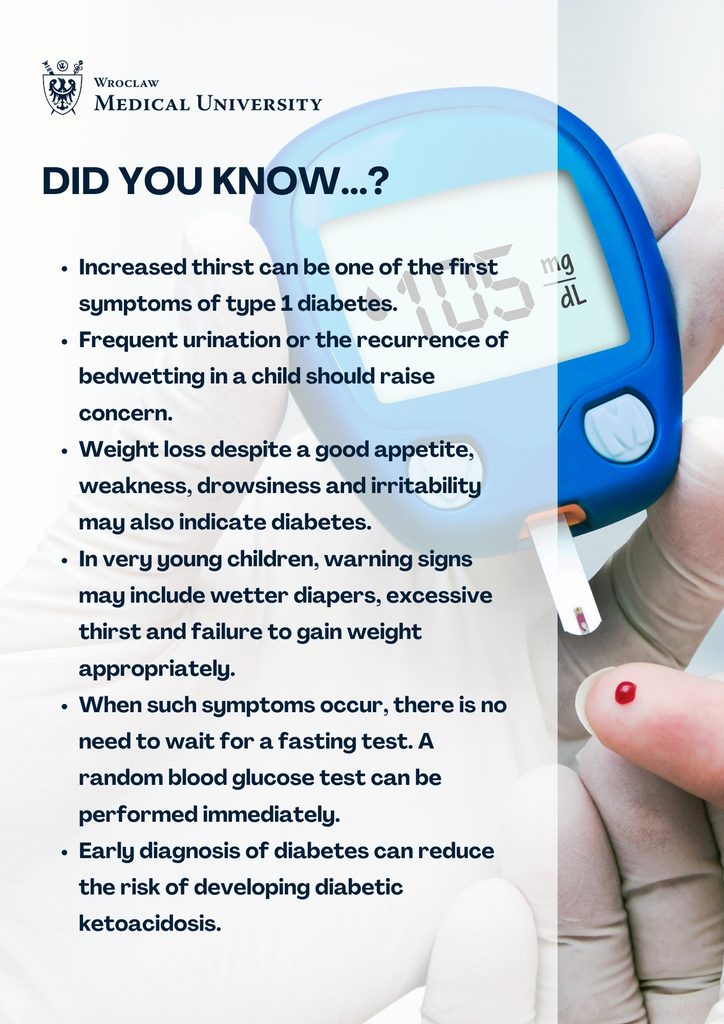
Type 1 diabetes can develop relatively quickly in a child. Some of the most characteristic warning signs are increased thirst and more frequent urination. A child who had previously stopped bedwetting and suddenly starts wetting the bed again should also raise concern.
Other warning signs include unintentional weight loss, marked weakness, drowsiness, irritability, a general decline in well-being, or increased appetite with weight loss. In very young children, the signs may be less obvious. A child may demand drinks more frequently, have wetter diapers more often, become lethargic or restless, fail to gain weight as expected, or begin to lose weight.
If increased thirst, frequent urination, weight loss, or unexplained weakness occur, blood glucose levels should be checked without unnecessary delay. No need to wait for a fasting test. If symptoms are already present, a random blood glucose test can be performed regardless of how much time has passed since the last meal, explains Agnieszka Zubkiewicz-Kucharska, MD, PhD.
The nationwide analysis also underscores the importance of prompt diagnosis. The researchers indicate that educating parents and healthcare professionals, recognizing characteristic symptoms, and quickly measuring blood glucose levels may help reduce the number of children admitted to hospital only after diabetic ketoacidosis has already developed.
Can diabetes be detected before symptoms appear?
Type 1 diabetes is an autoimmune disease. The immune system gradually destroys the insulin-producing cells of the pancreas, and this process begins before the symptoms that ultimately lead to diagnosis become apparent.
Screening can detect characteristic autoantibodies associated with this process. A child identified as having an early stage of type 1 diabetes can be monitored regularly while still feeling well and before any symptoms develop.
This also helps prevent diabetic ketoacidosis. Data from the Fr1da screening program cited in the publication show that among children identified in the presymptomatic stage of type 1 diabetes, ketoacidosis at the time of clinical onset occurred in fewer than 5–10% of children. In groups diagnosed only after symptoms appeared, the proportion was approximately 20–50%.
The most important benefit of screening is not simply making the diagnosis earlier. We can monitor a child during the period when there are no symptoms yet. Parents know what to look out for, and the child remains under specialist diabetes care. This allows us to diagnose the disease before severe hyperglycemia and diabetic ketoacidosis develop, says Agnieszka Zubkiewicz-Kucharska, MD, PhD.
Screening does not, however, replace a standard blood glucose measurement once symptoms have appeared. If a child begins drinking excessively, urinating frequently, starts bedwetting again, loses weight or becomes noticeably weak, blood glucose should be checked urgently.
From responding to symptoms to earlier detection
Researchers are currently developing screening for type 1 diabetes using different models. It may target children at increased risk, primarily first-degree relatives of people with type 1 diabetes, or it may cover the entire pediatric population. The publication cites, among other examples, European screening programs and the approach adopted in Italy, where legislation on population-based screening of children for type 1 diabetes and celiac disease was passed in 2023.
In Poland, population-based screening is currently conducted mainly through research projects. Children from families affected by type 1 diabetes can have their autoantibodies tested at pediatric diabetes centers, including the Department and Clinic of Pediatrics, Endocrinology, Diabetology and Metabolic Diseases at Wroclaw Medical University.
The authors of the nationwide analysis emphasize the need for action at several levels: increasing awareness of early diabetes symptoms, strengthening diagnostic vigilance in primary healthcare, improving access to rapid blood glucose testing, and expanding opportunities to detect diabetes before symptoms develop.
The study findings illustrate the scale of the challenge. The analysis covered all 16 Polish voivodeships and almost the entire Polish pediatric population with newly diagnosed type 1 diabetes. Despite a decline from the pandemic peak, the frequency of diabetic ketoacidosis remained high.
Publication:
Persistently increased frequency of diabetic ketoacidosis in new-onset type 1 diabetes in Polish children: nationwide analysis 2019–2022, Frontiers in Endocrinology.
Frontiers in Endocrinology, 29 June 2026
Section: Clinical Diabetes
Volume 17, 2026
DOI: 10.3389/fendo.2026.1861694