

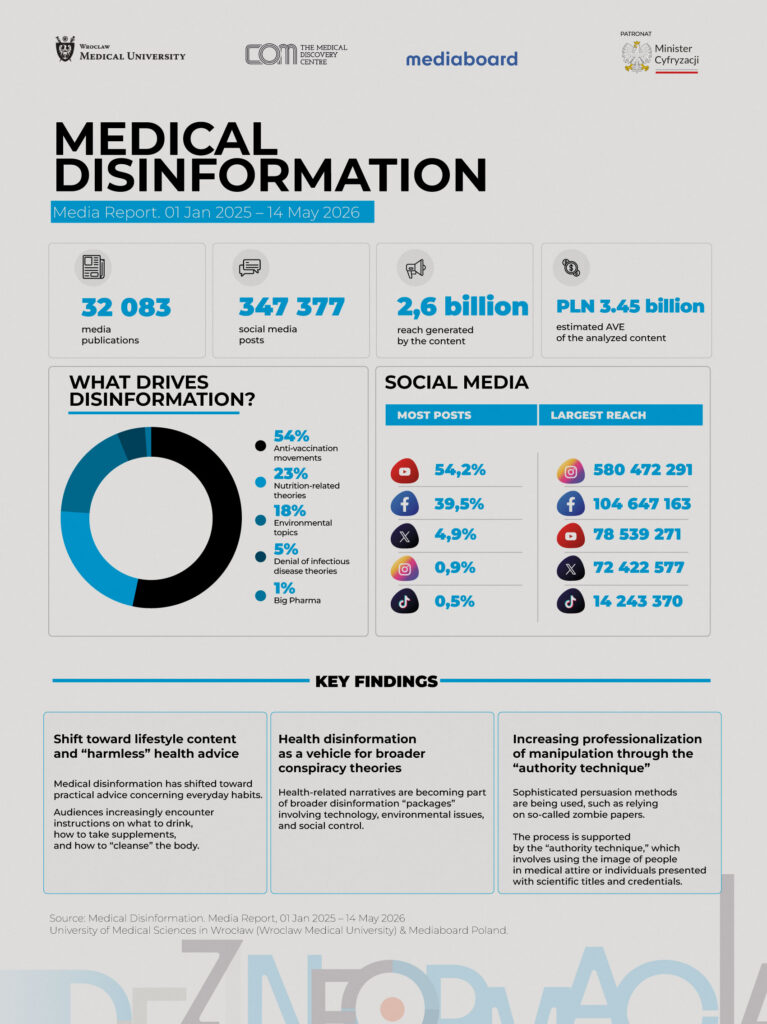
More than 32,000 publications in traditional media, over 347,000 social media posts, and hundreds of millions of content impressions – this is the scale of the debate on medical disinformation in Poland. A report prepared by Wroclaw Medical University and Mediaboard reveals not only which false health-related narratives appear most frequently, but also how their nature has evolved. Today’s disinformation is less likely to resemble a classic conspiracy theory. Instead, it increasingly takes the form of practical advice: what to eat, which supplements to take, how to “cleanse” the body, and why doctors should not be trusted.
Health concerns everyone. One does not need to be interested in politics, economics, or technology to eventually become a patient, a parent, a caregiver, or someone seeking help for a loved one. This is precisely why medical misinformation is so dangerous. It does not end with an online comment. It can influence decisions about whether to get vaccinated, undergo medical tests, start treatment, trust a physician, or choose a method recommended by a self-proclaimed expert instead of evidence-based therapy.
– As a physician and a scientist, I have no doubt that knowledge alone is no longer enough. What matters today is whether we are able to communicate it effectively, – emphasizes Prof. Piotr Ponikowski, Rector of Wroclaw Medical University. – Medical disinformation poses a genuine threat to human life and, consequently, to national security. We must start speaking about it openly and clearly.
The Scale of the Phenomenon
The report Medical Disinformation examined content in both traditional and social media relating to health, prevention, treatment, vaccination, alternative medicine, and artificial intelligence in healthcare. During the analyzed period, from 1 January 2025 to 14 May 2026, more than 32,000 publications were identified across online news portals, print media, radio, and television. These generated over 2.6 billion content impressions, while their estimated Advertising Value Equivalency (AVE) exceeded PLN 3.45 billion. In social media, 347,377 posts were monitored, reaching a combined audience of more than 850 million impressions.
These figures reflect the scale of the overall public debate rather than the activity of disinformation communities alone. The report covers both false content and expert, informational, and fact-checking materials that analyzed or debunked misleading narratives. The conclusion is clear: medical disinformation has entered the mainstream. It now operates at the intersection of media, social platforms, politics, law, marketing, and the everyday decisions of patients.
The security dimension of the issue is also highlighted by Krzysztof Gawkowski, Deputy Prime Minister, Minister of Digital Affairs, and Government Plenipotentiary for Cybersecurity.
– Health-related disinformation, including medical disinformation, remains particularly dangerous. It poses a serious threat to public safety, especially when amplified by cyberattacks, fraudulent websites, and manipulation through social media.
The report also reveals an important shift in the types of false narratives being disseminated. Anti-vaccination content still accounts for the largest share of disinformation, representing 54 percent of all identified narratives. However, nutrition- and lifestyle-related theories now rank second, accounting for 23 percent. Environmental narratives—including chemtrails, 5G, Wi-Fi, and water fluoridation—follow with a 16 percent share.
– Medical disinformation is no longer a collection of isolated fake news stories. Today, it forms an entire ecosystem of narratives, – explains Dr. Dorota Sikora of Wroclaw Medical University. – It connects anti-vaccination movements, ‘hidden truth’ theories, pseudotherapy practices, and health influencers without medical qualifications. Its power lies not only in false information, but in its ability to exploit our emotions.
Nutrition Narratives Rise to the Top
Following the COVID-19 pandemic, medical disinformation became closely associated with anti-vaccination narratives. The report shows, however, that this picture is now incomplete. False messages increasingly begin with seemingly harmless advice: “boost your immunity,” “check for parasites,” “eliminate the root cause,” or “doctors will not tell you this.” Such messages do not sound like direct attacks on science. Instead, they appeal to concerns about health, self-reliance, and regaining control over one’s body.
This is a particularly dangerous mechanism. Lifestyle-related disinformation draws upon genuine concepts from medicine, biology, and nutrition, but combines them with false promises. Diet does affect health, the gut microbiome is an important area of research, and physical activity matters. The problem begins when legitimate scientific findings are used to support claims that diet can replace cancer treatment, fasting can “reset” the body, or high doses of vitamins can cure serious diseases.
A significant section of the report focuses on HPV vaccination. In some social media discussions, the topic of cancer prevention was transformed into a cultural conflict. Narratives emerged about the “sexualization of children,” government interference in parental rights, and alleged “experimentation on children.”
– HPV vaccines are among the most thoroughly researched vaccines available, yet they have become a target of disinformation that directly contributes to increased rates of cancer and preventable deaths, – notes Dr. Kamila Ludwikowska, Vice-Dean for Development and Innovation at Wroclaw Medical University and Deputy Head of the Department of Pediatrics and Infectious Diseases.
Dominant Communication Channels
The report also examines the role of platforms and emerging authorities. Among social media channels, YouTube accounted for 54.2 percent of all content related to medical disinformation. Video formats are particularly effective at building trust. Creators show their faces, speak in simple language, share patient stories, and offer concrete solutions. In pseudomedical content, personalization becomes one of the key tools for establishing credibility.
Artificial intelligence represents an additional risk. The report discusses AI-generated doctors, deepfakes, and advertisements promoting miracle supplements. A fake physician wearing a white coat, speaking calmly and promising a simple cure, may be far more convincing than an anonymous online comment. Technology makes it easier to produce content that appears professional while steering audiences toward potentially harmful decisions.
One of the key mechanisms identified in the report is the so-called authority technique. Disinformation frequently relies on white coats, academic titles, graphs, references, and complex terminology. Another phenomenon highlighted is that of “zombie papers” – discredited or retracted scientific publications that continue to circulate online and are cited as evidence long after they have lost scientific credibility.
The report’s conclusions are unequivocal. Medical disinformation is not merely an internet problem. It affects health decisions made by real people, often during times of illness, fear, and time pressure. Addressing it requires cooperation among physicians, scientists, educators, journalists, fact-checkers, lawyers, and public institutions.
The Medical Discovery Centre currently being established at Wroclaw Medical University is intended to serve as a response to this challenge. As Wioletta Samborska, Director of the Centre, explains, the initiative aims to become a “vaccine against disinformation.” Its role will be to strengthen society’s resilience to manipulation before false information translates into health-related decisions.
Medical disinformation is a public health issue. As such, it deserves the same level of attention and seriousness as any other threat affecting the safety and well-being of patients, the report’s authors conclude.
Read the full report in polish: Medical Disinformation Report – Wroclaw Medical University.