

Over the past few years, kombucha has become one of the world’s most popular fermented beverages. While most consumers focus primarily on its taste, scientists are increasingly analyzing its chemical composition and potential biological properties. Researchers from the Wrocław University of Environmental and Life Sciences and Wroclaw Medical University (Associate Professor Helena Moreira, PhD, Associate Professor Ewa Barg, PhD, and Anna Szyjka, MSc Eng.) have now investigated how the type of tea used influences the final characteristics of the beverage, and the differences turned out to be far greater than previously expected.
The interdisciplinary team of scientists compared kombuchas prepared from black, green, white, oolong, and pu-erh teas. The results were published in the journal Food Chemistry.
– The type of tea acts as a specific matrix that shapes the course of fermentation and the final composition of kombucha, explains Associate Professor Helena Moreira, PhD, from the Department of Basic Medical Sciences and Immunology, Wroclaw Medical University. – Individual teas differ in their content of polyphenols, catechins, caffeine, and other bioactive compounds, which are subsequently metabolized by SCOBY microorganisms. As a result, fermentation proceeds with different dynamics, and the final beverages differ in both chemical and aromatic profiles.
Fermentation that changes the composition of the beverage
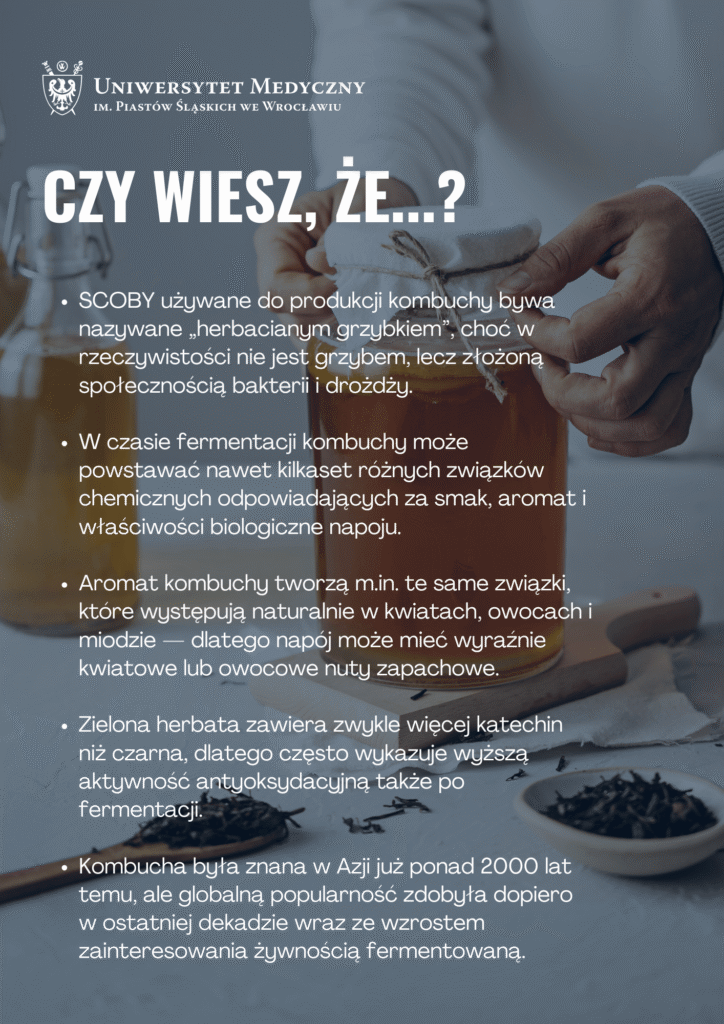
Kombucha is produced thanks to the activity of SCOBY — a symbiotic culture of bacteria and yeast — which ferments sweetened tea. During this process, intensive biochemical transformations occur. Yeasts break down sugars into alcohol and carbon dioxide, while bacteria further convert them into organic acids, mainly acetic and gluconic acids. These are responsible for the beverage’s characteristic sour taste.
The composition of bioactive compounds present in tea also changes. The scientists observed transformations in polyphenols, catechins, and volatile aromatic compounds responsible for kombucha’s flavor and aroma.
– At the same time, transformations of polyphenols and volatile aromatic compounds present in tea take place. As a result, the beverage acquires its characteristic sour, lightly sparkling taste and a more complex aroma, explains Associate Professor Helena Moreira, PhD.
The analyses demonstrated a clear increase in the concentration of compounds responsible for floral and fruity notes, such as linalool and 2-phenylethanol. These substances also occur naturally in flowers and essential oils. At the same time, some compounds characteristic of freshly brewed tea disappeared during fermentation, while new metabolites produced by SCOBY bacteria and yeast took their place.
The researchers used advanced chromatographic techniques and mass spectrometry to precisely track the changes occurring in the beverage during fermentation. This allowed them to compare hundreds of chemical compounds present in kombuchas prepared from different types of tea.
– The most surprising aspect was the scale of changes occurring during fermentation and how strongly they depended on the type of tea used – says the scientist. – Despite identical fermentation conditions, we obtained kombuchas with highly distinct profiles of volatile aromatic compounds.
Green and oolong performed best
The research also showed that different types of kombucha may exhibit distinct biological properties. Kombuchas prepared from green and oolong teas exhibited the highest antioxidant activity and the greatest ability to neutralize free radicals.
Free radicals are reactive molecules that can damage cells and accelerate aging; therefore, compounds with antioxidant activity are intensively studied for their potential impact on health.
– The results of our research indicate that the type of tea influences not only the taste and aroma, but also the biological activity of kombucha – emphasizes Associate Professor Helena Moreira, PhD. – Particularly interesting results were obtained for kombuchas prepared from green and oolong teas, which demonstrated the highest biological potential.
The scientists stress, however, that although the laboratory findings are promising, it is not yet possible to draw definitive conclusions about specific health effects in humans.
– Further clinical studies are necessary to clearly confirm the impact of particular types of kombucha on human health, adds the researcher.
Not every kombucha is the same
The growing interest in kombucha reflects a broader trend in research on fermented foods. Fermentation may increase the bioavailability of bioactive ingredients, generate new metabolites, and influence the gut microbiota.
– Fermented foods are currently at the center of scientific interest because they combine traditional technologies with a modern approach to health and nutrition – says Associate Professor Helena Moreira, PhD. – Kombucha is a very good example of a product in which chemical composition, biological activity, and sensory profile result from complex interactions between the raw material and fermentative microorganisms.
The research also shows that kombucha is not one universal product. In practice, each tea can create a beverage with a different character, both in terms of flavor and chemistry. Kombucha made from green teas was characterized by a fresher, more vegetal aromatic profile; oolong produced more pronounced floral and fruity notes, whereas kombuchas made from black tea and pu-erh had a heavier, earthier, and more fermentation-like aroma.
Material based on the article:
Matrix-dependent modulation of chemical composition, volatile profile, and biological activity of kombucha beverages from different tea types
Food Chemistry
https://doi.org/10.1016/j.foodchem.2026.149160
Authors: Akshay K. Chandran, Marcelina Stach, Jacek Łyczko, Zbigniew Lazar, Joanna Kawa-Rygielska, Helena Moreira, Anna Szyjka, Ewa Barg, Joanna Kolniak-Ostek