

It is one of the least known yet most aggressive skin cancers. Merkel cell carcinoma grows rapidly, can remain undiagnosed for a long time, and metastasizes early. New European guidelines, co-authored by Prof. Piotr Donizy from Wroclaw Medical University, are intended to improve its early and accurate detection.
Merkel cell carcinoma is a rare but highly aggressive skin cancer. It occurs most often in older adults and has a strong tendency to spread quickly, especially to nearby lymph nodes. This is why precise diagnostics at an early stage of the disease are so important.
Updated recommendations regarding the assessment of the so-called sentinel lymph node in patients with Merkel cell carcinoma have just been published in the leading European oncology journal, European Journal of Cancer. Among the co-authors of the document are Prof. Piotr Donizy, head of the Department of General and Experimental Pathology at Wroclaw Medical University, and Dr. Jakub Mizera, a participant in the university’s Doctoral School. The guidelines were developed by an international team of experts working within the European Organisation for Research and Treatment of Cancer under the leadership of Prof. Daniela Massi, a renowned specialist in dermatopathology and oncology.
These are currently the most important recommendations concerning sentinel lymph node assessment in Merkel cell carcinoma. Since there are no separate, universally accepted global guidelines in this area, the document prepared by EORTC experts will in practice become an important reference point beyond Europe as well.
The new recommendations organize the principles for evaluating material collected from the so-called sentinel lymph node — the first lymph node to which cancer cells may spread. This examination plays a crucial role in determining the stage of the disease and choosing further treatment.
More Deceptive Than Melanoma
Although melanoma is discussed increasingly often today, Merkel cell carcinoma remains largely unknown. Many patients hear its name for the first time only in a doctor’s office after reading a histopathology report, even though it is an exceptionally aggressive and rapidly developing disease.
As Prof. Piotr Donizy emphasizes, this lack of public awareness is one of the biggest problems. Patients usually know they should monitor moles or lesions associated with melanoma, while Merkel cell carcinoma may look completely different — and for that reason is easier to overlook.
This cancer arises from neuroendocrine cells of the skin. It most commonly appears on the face, scalp, neck, or forearms. However, it cannot simply be reduced to a “sun-related cancer.”
“In Merkel cell carcinoma, we are dealing with two main mechanisms of disease development. One is associated with UV radiation, the other with infection by the Merkel cell polyomavirus. This makes its biology more complex than that of many other skin cancers,” explains Prof. Piotr Donizy.
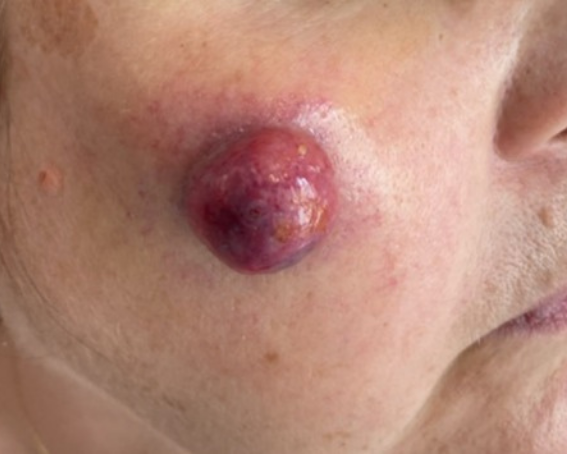
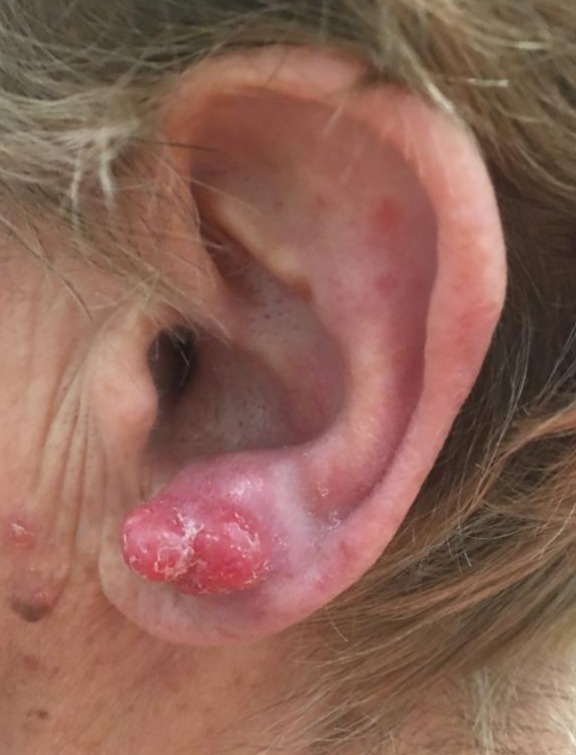
This complexity is one reason why Merkel cell carcinoma has not entered public awareness in the same way melanoma has. At the same time, it can be even more insidious. It does not begin as a clearly “suspicious” mole, but rather as an inconspicuous red lump that initially may not appear dangerous, imitating inflammatory lesions or allergic reactions.
A Tumor That Grows Within Weeks
One of the most characteristic features of Merkel cell carcinoma is the speed of its growth. This is a cancer that can develop very rapidly.
“In clinical practice, we sometimes see lesions grow within a few weeks from a barely visible dot to several centimeters in size. The patient may think it is something trivial, while in reality the tumor quickly reaches a size that cannot be ignored,” says Prof. Donizy.
The skin lesion in Merkel cell carcinoma is usually painless. It may be red, pink, bluish-purple, or skin-colored. Sometimes it resembles a benign lump or cyst. This is one of the main diagnostic traps.
The absence of pain and the lack of the typical appearance known from melanoma awareness campaigns mean that patients do not always consult a doctor immediately. In addition, the rarity of the disease itself may delay proper diagnosis.
A Disease Diagnosed Increasingly Often
Merkel cell carcinoma belongs to the group of rare cancers, but the number of diagnoses is gradually increasing. This is related, among other factors, to population aging, greater oncological awareness, and increasingly advanced pathological diagnostics.
Currently, around 250 cases of Merkel cell carcinoma are diagnosed annually in Poland. At the same time, Prof. Piotr Donizy points out that the true number of cases may be underestimated.
“We suspect there are more of these cancers than statistics show, because some cases may not be properly diagnosed at all,” says Prof. Donizy.
Why the Sentinel Lymph Node Matters
A key element in the diagnostics of Merkel cell carcinoma is examination of the so-called sentinel lymph node. This is the first lymph node to which lymph fluid drains from the area around the tumor. If the cancer begins to spread, the first cancer cells often appear there.
The results of this examination determine the stage of the disease and the plan for further treatment. In Merkel cell carcinoma, this is particularly important because the first metastatic foci may be microscopic and invisible on imaging scans.
“In Merkel cell carcinoma, we look for even a single cancer cell in the sentinel lymph node. This best illustrates how precise the diagnostics must be. Sometimes it is not about a large metastasis, but about a microscopic trace of disease that determines further management,” emphasizes the Wroclaw Medical University scientist. “In Merkel cell carcinoma, rapid and precise diagnosis has a direct impact on treatment. The more accurately the disease stage is assessed, the better further management can be planned.”
New Guidelines Standardize Diagnostics
The new recommendations prepared by experts from the European Organisation for Research and Treatment of Cancer are intended to standardize the assessment of sentinel lymph nodes in patients with Merkel cell carcinoma across pathology laboratories throughout Europe. The document describes in detail, among other things, methods for preparing tissue samples, techniques for sectioning lymph nodes, and the use of immunohistochemical tests capable of detecting even very small metastatic foci.
The importance of this publication goes beyond histopathological diagnostics alone. It is an important step toward more uniform standards of care in Europe and, at the same time, proof that Polish scientists are co-creating solutions with a real impact on patient care. The participation of Prof. Piotr Donizy and Dr. Jakub Mizera in preparing these recommendations demonstrates that experts from Wroclaw Medical University are active members of international teams shaping the future directions of modern oncology.
“Merkel cell carcinoma is a rare disease, which is why international collaboration is extremely important. Only through joint projects and the analysis of experience from many centers can we improve diagnostics and treatment for patients,” says Prof. Piotr Donizy.