New ESC Guidelines: Cardiac rehabilitation as an integral part of treatment
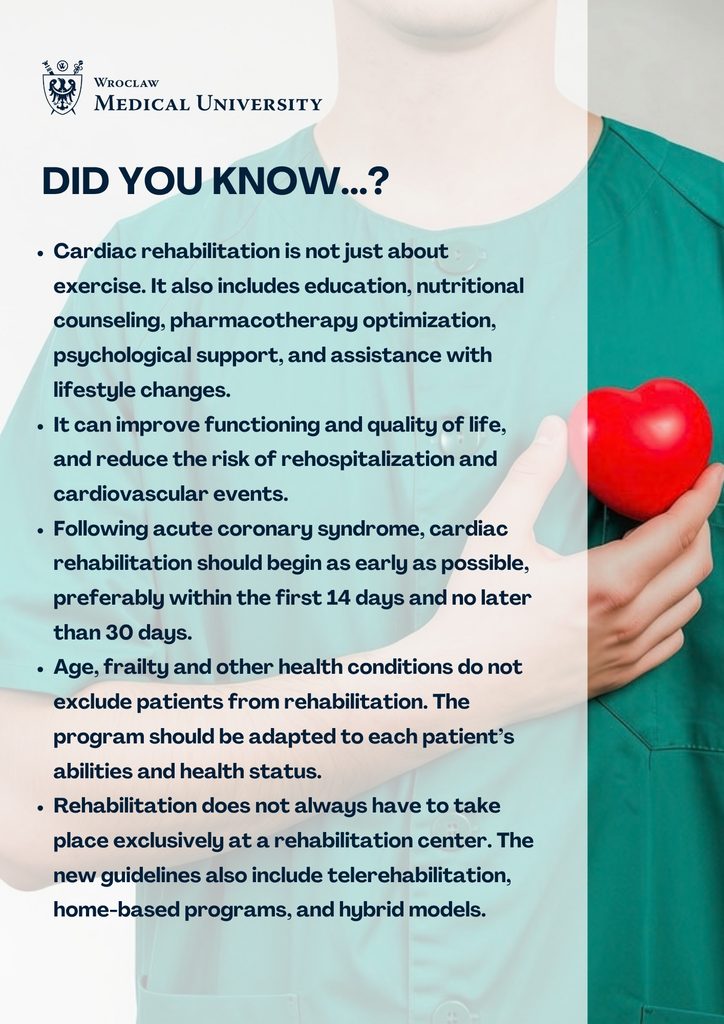
Cardiac rehabilitation is much more than exercise after a heart attack or heart surgery. It is an integral part of treatment that also includes risk factor management, appropriate nutrition, medication optimization, education, and psychological support. The European Society of Cardiology (ESC) presents this comprehensive approach in its new guidelines. One of their co-authors is Associate Professor Michał Czapla from Wroclaw Medical University.
The 2026 ESC Guidelines on Cardiac Rehabilitation are the first European Society of Cardiology guidelines devoted entirely to cardiac rehabilitation. The document was published in August 2026 in the European Heart Journal.
The authors emphasize that rehabilitation should be part of the entire care pathway for patients with cardiovascular disease, rather than a separate stage that begins only after main treatment ends. It can start during hospitalization and then continue at a rehabilitation center, at home, or through telerehabilitation.
The new guidelines clearly change the way we think about cardiac rehabilitation. It is not an add-on or a stage that comes ‘after treatment’, but an integral part of cardiovascular disease management and long-term secondary prevention. It is a comprehensive, multidisciplinary intervention aimed not only at restoring physical fitness, but also at improving patients’ overall functioning and reducing the risk of further cardiovascular events, emphasizes Associate Professor Michał Czapla, Chair of the Health Sciences Discipline Council at Wroclaw Medical University.
More than regaining physical fitness
The benefits of rehabilitation go beyond enabling patients to walk farther, climb stairs more easily or return to their everyday activities sooner. The guidelines also point to improvements in quality of life and psychological well-being, as well as clinical benefits, including a lower risk of rehospitalization.
The evidence is particularly strong for patients following acute coronary syndrome and those with chronic coronary syndrome. In this group, cardiac rehabilitation is recommended, among other reasons, to reduce the risk of cardiovascular death, myocardial infarction, and hospitalization.
By not participating in cardiac rehabilitation, patients miss the opportunity not only to improve their exercise capacity and physical fitness safely, but also to achieve better symptom control and quality of life. Rehabilitation helps patients gradually and safely return to everyday activities, work and social functioning. Its importance, however, extends beyond physical fitness. Comprehensive cardiac rehabilitation is an element of secondary prevention and may also reduce the risk of subsequent hospitalizations and improve long-term prognosis, explains Dr Krzysztof Aleksandrowicz from the University Center for Physiotherapy and Rehabilitation and the Faculty of Physiotherapy at Wroclaw Medical University.
Cardiac rehabilitation is much more than exercise
Physical training remains a core component of rehabilitation, but the new guidelines present a much broader model of care. The program should be tailored to each patient’s health status, abilities and individual needs.
It includes patient assessment, appropriately selected physical activity, education, support in changing everyday habits, optimization of pharmacological treatment, nutritional counseling, smoking cessation support and psychosocial care. The guidelines even address areas such as returning to work and sexual health.
Cardiac rehabilitation is definitely much more than physical exercise. The new guidelines emphasize that it should also include optimizing pharmacotherapy, nutritional interventions, smoking cessation, education, psychosocial support, and preparing patients to manage their condition independently. This is why it requires cooperation between many professionals, including physicians, nurses, physiotherapists, dietitians and psychologists. The aim is not only to improve physical fitness, but to comprehensively reduce the risk of further cardiovascular events, says Associate Professor Michał Czapla.
The guidelines pay particular attention to older people, patients with multiple chronic conditions and those living with frailty. Age, multimorbidity or frailty alone should not be reasons to exclude someone from rehabilitation. Instead, the program should be appropriately adapted, with an emphasis on safety, improved functioning and the patient’s individual capabilities.
This is particularly important because cardiac rehabilitation is now recommended or considered for a much broader group of patients than only those recovering from a heart attack. The guidelines cover, among others, patients with heart failure, valvular heart disease, atrial fibrillation and cardiomyopathies, people with implanted cardiac devices, as well as selected patients undergoing cancer treatments that may damage the cardiovascular system.
Bringing rehabilitation closer to patients
One of the greatest challenges remains access. The guidelines note that cardiac rehabilitation remains underused worldwide. Depending on the population analyzed, only a proportion of patients eligible for rehabilitation actually participate in a program.
The solution does not necessarily lie solely in expanding traditional center-based rehabilitation programs. The new recommendations extensively address home-based rehabilitation, telerehabilitation and hybrid models combining face-to-face and remote care. Select the mode of rehabilitation based on the patient’s clinical risk, needs, and individual circumstances.
From the perspective of the Polish healthcare system, increasing real access to cardiac rehabilitation is particularly important. The new guidelines indicate that different models can be used, including telemedicine, which may make participation easier for older people or those living far from rehabilitation centers. Importantly, age, frailty or multimorbidity should not in themselves constitute barriers to rehabilitation. The key challenge is therefore to ensure that patients who indicate rehabilitation can actually access it, concludes Associate Professor Michał Czapla.
The new guidelines therefore shift the focus from simply “restoring fitness” towards comprehensive, long-term treatment. Physical activity remains an important component, but it is accompanied by risk factor management, pharmacological treatment, nutrition, mental health support, education, and preparation for independent living with cardiovascular disease. Rehabilitation should help patients not only regain their functional capacity, but also maintain it for as long as possible.
Publication:
2026 ESC Guidelines on cardiac rehabilitation: Developed by the task force on cardiac rehabilitation of the European Society of Cardiology (ESC).European Heart Journal, 2026. DOI: 10.1093/eurheartj/ehag099.