

Obesity is increasingly referred to as a chronic disease. This is also how it is defined in the recommendations of scientific societies. In practice, however, many women who decide to undergo pharmacological treatment still face judgment from those around them, and often also their own feelings of shame. A study conducted by a team of researchers from Wroclaw Medical University shows that although we declare our acceptance of obesity, pharmacotherapy is still sometimes perceived as a “shortcut.”
The voice of a thousand Polish women
The online survey was completed by 1,043 adult women living in Poland. As many as 97% of them considered obesity to be a disease, and almost all agreed that it requires treatment. This result shows a huge change in social awareness compared to surveys conducted several years ago.
At the same time, the participants’ responses revealed that there are still strong, often moralizing narratives surrounding anti-obesity drugs. Analysis of the results showed clear correlations:
- older age was associated with more stigmatizing attitudes towards pharmacotherapy,
- higher BMI was more often associated with the belief that seeking treatment is a cause for shame,
- personal experience with medication significantly reduced the level of stigmatization and self-stigmatization.
As Dr. Agnieszka Mastalerz-Migas, professor at the Department of Family Medicine, points out:
In some groups, there was a stronger belief that obesity is not a disease requiring treatment, and a narrative that the use of anti-obesity drugs is an “easy way out” and a cause for shame. Older age, the researcher adds, clearly correlated with a more critical attitude towards pharmacotherapy, while higher body weight was more often associated with the belief that treatment is something shameful. It is this element that is interpreted as a manifestation of self-stigmatization, i.e., the internalization of social stereotypes.
Change in experiences
The lowest level of stigmatization and self-stigmatization was observed among women currently using medication. The very fact of starting therapy proved to be a factor that changed the way they thought. This applied to both themselves and other patients.
As emphasized by Dr. Mateusz Babicki, assistant professor at the Department of Family Medicine, -People who undergo treatment have the opportunity to experience the extent to which decisions about nutrition have an impact beyond their conscious control. Pharmacotherapy is often a tool that enables lifestyle changes that previously seemed impossible to maintain.
In practice, the experience of treatment allows us to verify the three most common concerns:
- that everything depends solely on willpower,
- that medication “replaces” a healthy lifestyle,
- that pharmacotherapy is an easy and effortless solution.
Patients who underwent treatment more often emphasized that the drug does not eliminate the need to change habits, but rather makes it easier to maintain them – by regulating appetite, reducing hunger pangs, and stabilizing the weight-loss process.
Moralizing instead of medicine
The public debate is still dominated by the belief that obesity is primarily the result of a lack of self-discipline.
Meanwhile, modern medicine describes obesity as a complex metabolic disease in which genetic, hormonal, environmental, and psychological factors play a key role. Reducing it to a matter of “character” perpetuates stigmatization and can lead to delays in therapeutic decisions.
Health over opinion
The study also points to a clear generational theme—younger participants were more likely to have less stigmatizing attitudes toward treatment, although at the same time, they were more likely to report experiencing judgment from those around them. This shows that changing the social narrative is not a uniform process and requires consistent education.
As Dr. Mateusz Babicki sums up: -Obesity is a chronic disease with over 200 documented complications. The decision to seek treatment is an expression of self-care, not a cause for shame.
In practice, this means shifting the debate from moral judgments to medical facts, from blame to systemic support for patients.
If we treat obesity seriously as a chronic disease, we should treat all tools for its treatment, including pharmacotherapy, equally seriously. Understanding that reaching for medication is part of therapy and not an “admission of failure” may be one of the most important steps in realistically reducing stigma.
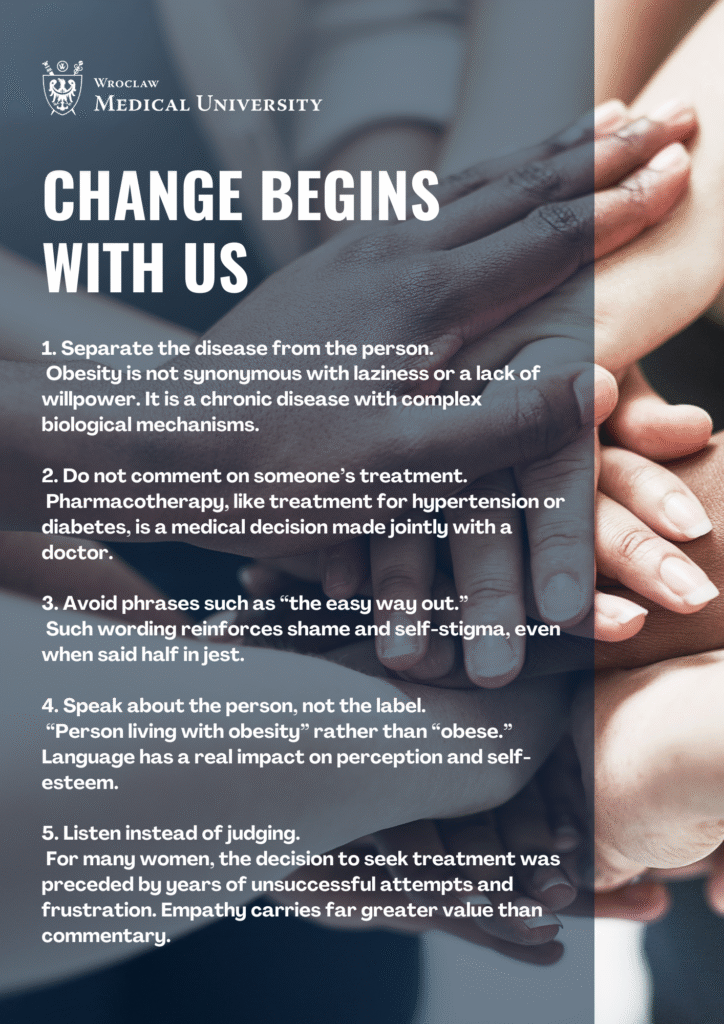
This material is based on the article:
Perceptions and stigma of anti-obesity pharmacotherapy in adult Polish women
Front. Public Health, January 12, 2026
Authors: Tomasz Witaszek, Karolina Kłoda, Agnieszka Mastalerz-Migas, Mateusz Babicki