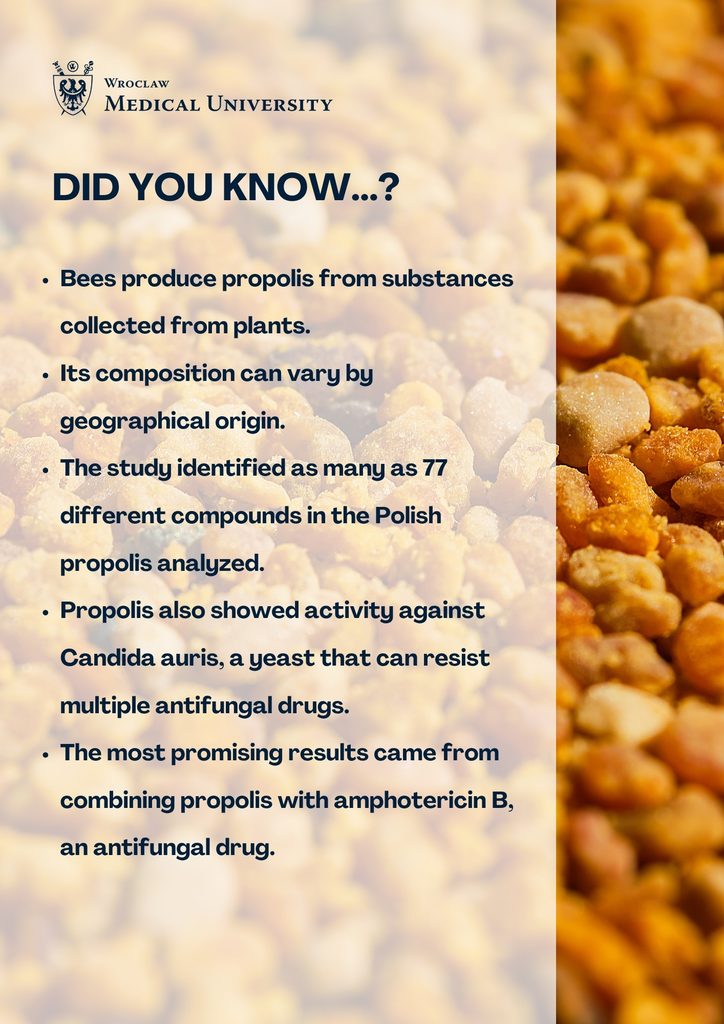
Propolis may not only inhibit the growth of certain fungi but also affect the activity of drugs used to treat fungal infections. Researchers investigated how an ethanolic extract of Polish propolis interacts with various antifungal agents.
The study, co-authored by Prof. Piotr Kuś from the Department of Pharmacognosy and Herbal Medicines at Wroclaw Medical University, was published in Scientific Reports. The researchers analyzed propolis activity against four yeast pathogens that cause candidiasis: Candida albicans, Nakaseomyces glabratus, Pichia kudriavzevii and Candida auris. They also investigated what happens when propolis extract is combined with different antifungal drugs.
Hundreds of сompounds in one natural substance
Propolis is a substance bees produce from plant material, wax, and their own secretions. Its composition depends, among other factors, on the plants growing around the hive. This means that propolis is not a single, easily defined substance, but a complex mixture of many chemical compounds.
The researchers identified 77 compounds in the extract they studied. Among the most important were flavonoids, including pinocembrin, chrysin, galangin and pinobanksin. Previous studies by the team suggested that specific combinations of these compounds may be responsible for some of propolis’s antifungal activity.
Propolis is a highly heterogeneous substance with a variable composition and activity, containing hundreds of chemical compounds. In our previous research, we attempted to identify the components responsible for its increased activity against Candida fungi. We found that selected flavonoids were particularly important. Interestingly, individual compounds showed moderate activity, unlike specific combinations of these compounds, says Prof. Piotr Kuś.
Propolis and antifungal drugs may work better together
One of the study’s most important aspects was investigating how propolis behaves when combined with antifungal drugs. The researchers used several methods to determine whether the two substances enhance each other’s effects, add to each other’s activity, do not affect one another, or, conversely, act antagonistically.
The most consistent results were obtained for amphotericin B, an antifungal drug used, among other indications, to treat severe fungal infections. When combined with propolis extract, amphotericin B showed synergistic activity against all the yeast species tested in at least three of the four methods used. For C. auris, two methods indicated an additive effect, meaning that the effect was approximately equal to the sum of the effects of the two components.
Synergy, on the other hand, means the effect of combining two substances is greater than expected from their individual effects.
Adding propolis extract may increase the effectiveness of amphotericin B, making it possible to achieve stronger inhibition or elimination of the fungus with lower exposure to the individual substances, explains Prof. Kuś.
In the future, this mechanism could be of interest in developing combination therapies. These could allow lower drug doses, reduce adverse effects, and make it harder for microorganisms to develop resistance. At this stage, however, this remains a direction for further research rather than a treatment method ready for clinical use.
Not every combination is beneficial
The study also highlighted another equally important aspect of combining natural substances with medicines. Propolis did not enhance the activity of all the antifungal agents tested.
For some combinations, the researchers observed an additive effect or no significant interaction. Others showed antagonism, meaning that the combination may work less effectively than expected. This was observed, among others, in results involving caspofungin, clotrimazole, and ketoconazole.
A substance’s natural origin does not mean it is neutral when combined with medicines. Interactions can work both ways: they may enhance treatment effects or weaken them.
A challenging pathogen: Candida auris
The researchers focused on Candida auris. This yeast can cause healthcare-associated infections and may resist antifungal drugs.
The study provided some of the first evidence of propolis extract’s activity against this pathogen. According to the researchers, this is the first study to demonstrate that an ethanolic propolis extract can effectively eliminate C. auris under in vitro conditions.
Candida auris very often shows high resistance to commonly used antifungal drugs, which makes infections difficult to treat and poses a serious threat, particularly to hospitalized patients. Our observations may inspire further research, including studies on new combination therapies, Prof. Kuś emphasizes.
At the same time, the results concerning C. auris demonstrate why interactions between propolis and medicines need to be interpreted with caution. Beneficial interactions were observed with amphotericin B, but for some other drugs the results indicated either no beneficial effect or antagonism.
There is still a long way from the laboratory to treatment
The results do not mean that propolis can already be used as an adjunct to antifungal therapy. The experiments were conducted in vitro, meaning outside the human body, using microbial cultures. The authors note that next steps should include investigating the mechanisms behind the observed interactions and confirming efficacy in preclinical infection models.
Propolis itself also presents an important challenge. Its composition can vary by origin, so appropriate standardization would be necessary before any potential medical application could be considered.
There is still quite a long way to go, because the research has so far demonstrated activity only in vitro. Among other things, we would need to determine the mechanism of action and a method for standardizing the extract, develop an appropriate formulation, conduct studies in animal models and then proceed to clinical trials, Prof. Kuś explains.
Sleep quality and chAs the researcher adds, natural substances often do not become medicines in their original form. They can, however, provide a starting point for developing new compounds. ronotype in primary headache disorders: a nationwide population-based study of 5,311 Polish adults
Most often, results obtained for substances of natural origin provide a basis for developing a candidate for a future drug. This could, for example, be a synthetic derivative with optimized efficacy, safety or pharmacokinetic properties, and it is only such a substance that would then undergo further testing, concludes Prof. Piotr Kuś.
Publication:
Piotr Bollin, Michał K. Pierański, Piotr Marek Kuś, Patrick Van Dijck, Piotr Szweda, Ethanolic extract of Polish Propolis exhibits synergy with selected antifungal agents against yeast pathogens causing candidiasis, Scientific Reports, 2026, vol. 16, article 21763.