

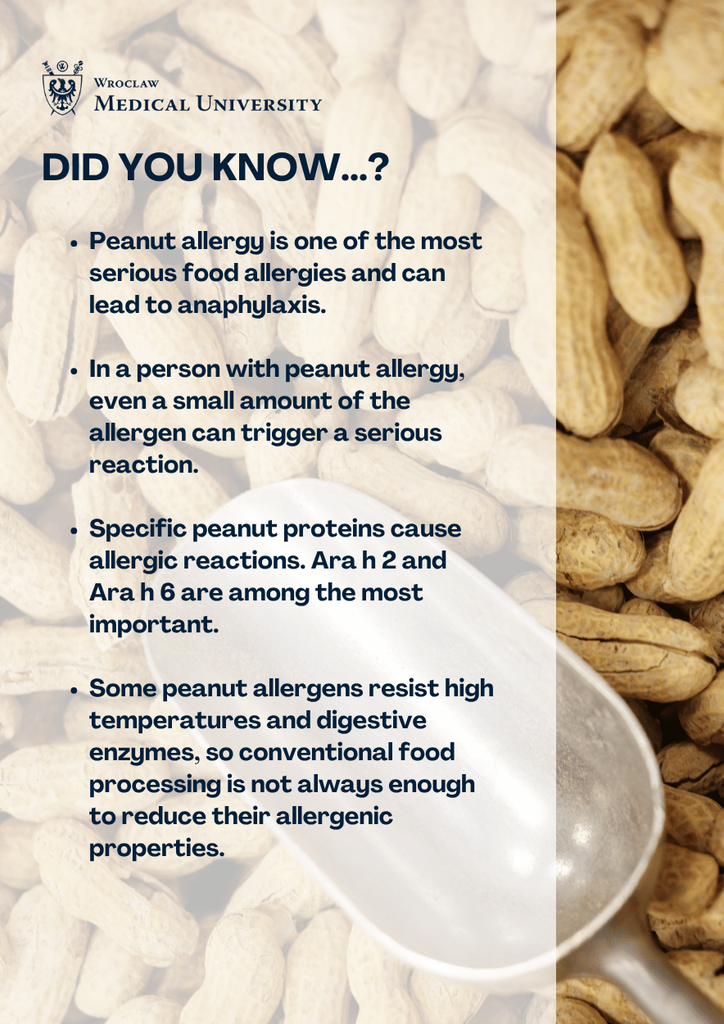
Peanut allergy is one of the most serious food allergies and can lead to sudden, life-threatening reactions. Researchers from Wroclaw University of Environmental and Life Sciences, in collaboration with Wroclaw Medical University, investigated whether a natural enzyme obtained from figleaf gourd (Cucurbita ficifolia) could reduce the ability of peanut proteins to be recognized by antibodies involved in allergic reactions.
The results show that enzymatic hydrolysis can significantly reduce the immunoreactivity of peanut proteins. The study does not yet produce a product that is safe for people with peanut allergy, but it points to an interesting direction for developing technologies aimed at designing functional foods with reduced allergenic potential.
Peanut allergy is particularly challenging because even a small amount of the allergen can trigger a serious reaction in sensitized individuals, including anaphylaxis. We are therefore looking for methods that can modify allergenic proteins and reduce their recognition by the immune system, explains Ewa Willak-Janc, MD, PhD, of the 1st Department and Clinic of Pediatrics, Allergology and Cardiology at Wroclaw Medical University and co-author of the publication.
The pumpkin enzyme precisely “cuts” proteins without destroying them
Enzymes used to hydrolyze plant and animal proteins are mainly commercial preparations of digestive enzymes. Using them individually, in combination, or with additional processes such as heat treatment can significantly reduce the allergenicity of many proteins. However, researchers are still searching for new enzymes from readily available sources that can efficiently hydrolyze proteins found in food and reduce their allergenicity more effectively. One promising group of enzymes for this purpose is non-commercial extracellular serine proteases obtained from figleaf gourd (Cucurbita ficifolia).
Protein structure is one factor that determines whether the immune system can recognize it. In people with allergies, antibodies react with specific protein fragments called epitopes. If enzymatic hydrolysis appropriately modifies protein structure, its ability to bind antibodies may be reduced. In the case of allergens, this approach is particularly interesting because it allows us not only to break down the protein, but above all to control changes in its properties, emphasizes Joanna Bajzert, PhD, Eng., from the Department of Immunology, Pathophysiology and Veterinary Prevention at Wroclaw University of Environmental and Life Sciences, an author of the publication.
The idea of using a pumpkin-derived protease was not accidental. Previous long-term studies by the team from Wroclaw University of Environmental and Life Sciences showed that this enzyme can effectively break down milk proteins and modify their properties. This time, the researchers investigated whether a similar approach could be applied to peanut proteins, one of the most important sources of food allergens.
Ara h 2 and Ara h 6: the main opponents
Researchers have identified many proteins with allergenic properties in peanuts. Ara h 2 and Ara h 6 are particularly important and are among the most potent peanut allergens. These proteins are relatively resistant to technological processing and digestion. Therefore, conventional food processing alone may not be sufficient to reduce their allergenic properties significantly.
Researchers at Wroclaw University of Environmental and Life Sciences therefore asked whether appropriately designed enzymatic hydrolysis could “cut” proteins in a way that would reduce antibody recognition.
The researchers prepared proteins from raw peanuts and treated them with figleaf gourd protease under different conditions. As the duration of enzyme activity increased, they observed progressively greater protein breakdown. Importantly, the duration and temperature of the process had the greatest impact on reducing immunoreactivity. This means that an appropriately designed enzymatic process can substantially alter the properties of peanut proteins.
Enzymatic hydrolysis significantly reduced protein immunoreactivity, but did not eliminate it. Smaller protein fragments remained after the process and could still be recognized by IgE antibodies. The allergens that retained the ability to react with antibodies included Ara h 2, Ara h 6, and Ara h 3.
This is a very important finding. We have shown that we can significantly reduce immunoreactivity, but hydrolysis alone is not sufficient to completely eliminate allergenic properties. Therefore, we cannot say that the resulting material is safe for people with peanut allergy, says Joanna Bajzert, PhD.
From allergy to functional foods
Research into the enzymatic modification of proteins has much broader implications. Hydrolysis does more than change protein size. The peptides produced during this process may have different biological and technological properties from the original protein. This opens up an interesting perspective for designing foods with specific functional properties.
In the future, controlled hydrolysis could be used to obtain food ingredients with reduced immunoreactivity, while also shaping peptide profiles and searching for products with desirable biological activity that could contribute to the health-promoting properties of foods.
Using naturally derived enzymes makes it possible to modify proteins precisely. We are interested not only in whether we can reduce their immunoreactivity, but also in what new properties we can obtain through controlled protein breakdown. This may be important for developing functional foods and designing new food ingredients, says Anna Mandecka, PhD, Eng., from the Department of Functional Food Products Development at Wroclaw University of Environmental and Life Sciences.
This is only the beginning
The next stage of the research will determine whether the protein fragments remaining after hydrolysis can activate cells involved in allergic reactions.
Functional studies, including basophil activation tests, will be particularly important. They will help determine whether the reduction in immunoreactivity observed in laboratory studies actually translates into a reduced ability of the hydrolysates to trigger an allergic reaction. Only these results will help assess the method’s potential practical application.
However, it is already clear that the enzyme derived from figleaf gourd could be an interesting tool for the controlled modification of plant proteins. The team’s research shows that using natural enzymes is one direction in developing technologies aimed at creating foods with new, precisely tailored properties.
The aim is not simply to “remove” the protein. The goal is to learn how to modify it appropriately and control the properties of the resulting peptides. This is what gives us the prospect of designing a new generation of food ingredients, concludes Anna Dąbrowska, PhD, DSc, from the Department of Functional Food Products Development at Wroclaw University of Environmental and Life Sciences, who initiated the research.
Publication
Pumpkin power: The influence of serine protease isolated from Cucurbita ficifolia on peanut proteins
Magdalena Wyspiańska, Anna Mandecka, Anna Dąbrowska, Ewa Willak-Janc, Joanna Miedzianka, Joanna Bajzert
Food Chemistry (2026)