

Statins are among the best-studied drugs used in the prevention of cardiovascular diseases. They reduce the risk of heart attack, stroke, and cardiovascular death. Despite this, many patients continue to fear them more than the disease itself. A study conducted by a team including researchers from Wroclaw Medical University shows that “statinophobia” is far from a marginal phenomenon — physicians encounter it almost every day.
Fear is stronger than the evidence
The authors surveyed 260 physicians, most of whom were affiliated with primary care and family medicine. They were asked about situations in which patients refused statin therapy due to concerns about adverse effects.
The results demonstrate the scale of the problem: 84% of physicians had encountered patients refusing treatment because of fear of muscle damage, while 81% had encountered concerns regarding liver damage. Patients also mentioned, although far less frequently, fears of diabetes, dementia, erectile dysfunction, cataracts, and prostate cancer.
The most widespread and at the same time most harmful myth is the belief that statins ‘destroy the liver’ or cause severe adverse effects in the majority of patients. In reality, these are well-studied and safe medications, and serious complications occur rarely. Another myth is the claim that if a patient ‘feels well,’ treatment is unnecessary — meanwhile, dyslipidemia remains asymptomatic for a long time, and lack of treatment increases the risk of cardiovascular events, – says Dr Mateusz Babicki from the Department and Division of Family Medicine.
When treatment ends without a physician’s decision
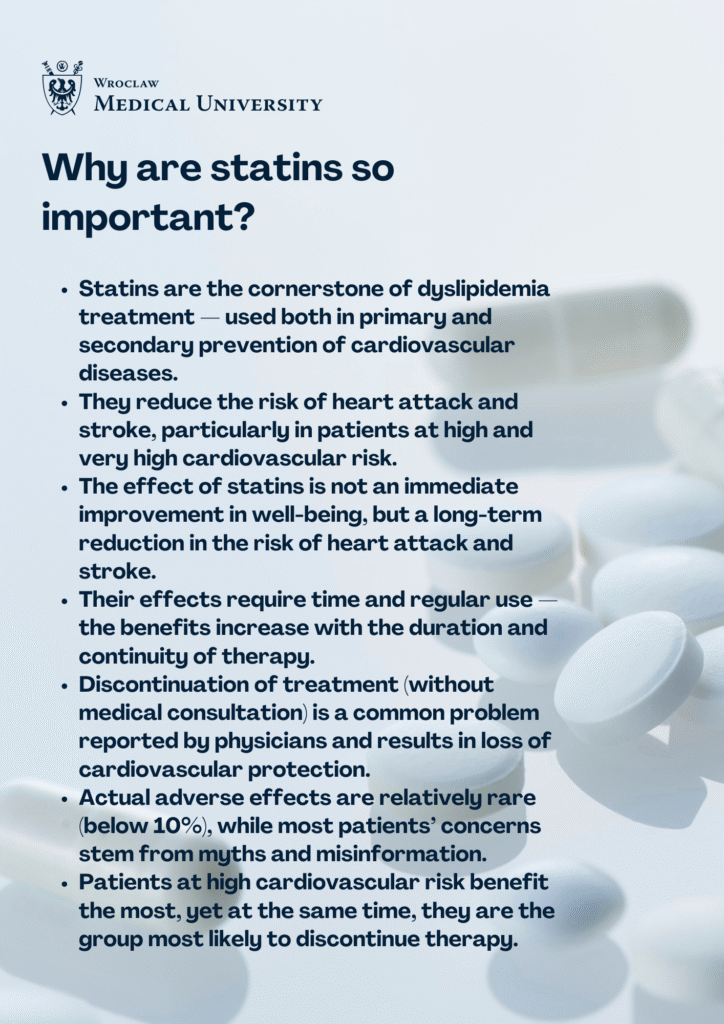
Most surveyed physicians estimated that 10–20% of patients discontinue statin therapy on their own initiative. At the same time, according to physicians’ experience, significant adverse effects occur in fewer than 10% of treated patients.
Among these adverse effects, the most commonly indicated reason for physicians to discontinue therapy was muscle-related symptoms or a significant increase in creatine kinase levels — this response was selected by 75% of physicians. What is particularly concerning is the increasingly common refusal of treatment resulting from patients’ false beliefs. This issue was raised by as many as half of the surveyed physicians (53%), – the authors noted.
One of the main reasons for discontinuing statin therapy is patients’ concerns regarding adverse effects — especially muscle and liver damage — often stemming from widespread myths rather than actual clinical data. Physicians also point to the impact of misinformation present in the media and on the internet, which undermines trust in treatment. Another significant factor is the occurrence of symptoms such as muscle pain, which are not always causally related to statins but nevertheless lead to treatment discontinuation, – emphasizes Dr Babicki.
The liver: patients’ most common fear
One of the strongest myths is the belief that statins damage the liver. However, the publication shows that such fears are often disproportionate to the actual risk.
The authors remind readers that a transient increase in aminotransferase activity may occur at the beginning of therapy, but it usually resolves spontaneously and does not necessarily indicate liver damage.
According to the ESC/EAS guidelines, an increase in ALT or AST below three times the upper limit of normal is not, in itself, a reason to discontinue treatment.
Muscles: not always the drug’s fault
The second most common reason for refusing treatment was fear of muscle damage. The authors point out that so-called SAMS (statin-associated muscle symptoms) may occur, but require proper interpretation.
In observational studies, such symptoms were reported in 7–29% of patients, whereas in randomized placebo-controlled trials the frequency was significantly lower, ranging from 1.5% to 5%.
The most severe complication, rhabdomyolysis, occurs very rarely: on average, in 1 out of 100,000 patients treated with statins.
The nocebo effect may also play an important role, a situation in which a patient expects adverse effects and therefore experiences them more frequently. In the SAMSON study, muscle-related symptoms were reported with similar frequency during statin and placebo administration.
Dementia, cataracts, prostate cancer — myths that keep returning
The study shows that some patients also fear less typical effects of statins. Seventeen percent of physicians had encountered concerns about dementia, 8% fears related to erectile dysfunction, 4% concerns about cataracts, and 3.5% fears of prostate cancer.
The authors emphasize that scientific evidence does not confirm these concerns. In the case of dementia, some studies even suggest a potential protective effect of statins.
There is also no evidence that statins increase the risk of cataracts or prostate cancer.
The issue of diabetes, however, is somewhat different. Twenty percent of physicians had encountered patients refusing therapy because of fears regarding diabetes development. The authors do not consider this a complete myth.
Statins may cause a slight, dose-dependent increase in the number of newly diagnosed diabetes cases, particularly in individuals with risk factors such as obesity, hypertension, or elevated triglyceride levels.
However, the key issue is balancing risks against benefits. The publication emphasizes that the slight increase in glycemia is already taken into account in the overall assessment, while the reduction in cardiovascular risk remains the dominant benefit of therapy.
Education exists. The problem is that myths spread faster
As many as 96.5% of physicians reported educating patients about statins. Nevertheless, refusals and self-discontinuation of therapy remain common. This is one of the publication’s most important conclusions.
Clear, honest, and individualized communication is essential. Patients should understand both the benefits (for example, a real reduction in the risk of heart attack or stroke) and the possible adverse effects, together with an emphasis on their actual frequency. It is also crucial to build a relationship based on trust and readiness to answer questions and dispel doubts, – explains Dr Babicki.
Those most at risk are also the patients who stand to gain the most.
Particular attention should be paid to patients at high and very high cardiovascular risk, who derive the greatest benefit from treatment and at the same time most often discontinue therapy, comments Dr Babicki.
Statins do not lose to evidence
The publication demonstrates that statins are not losing against science. They are losing against fear, oversimplifications, and beliefs that are sometimes stronger than the evidence itself.
Meanwhile, the decision to discontinue therapy may have very real consequences: increasing the risk of cardiovascular events and death.
Therefore, the key message is this: adverse effects should be recognized, monitored, and discussed with a physician, but they should not be confused with myths that deprive patients of effective prevention.
Read more
The material was prepared on the basis of the article:
Facts and myths about the use and effects of statins in patients with dyslipidemia: a survey of physicians
https://doi.org/10.5114/aoms/196806
Authors: Agata Hendzel, Filip Krzyżanowski, Karolina Kłoda, Agnieszka Mastalerz-Migas, Mateusz Babicki