

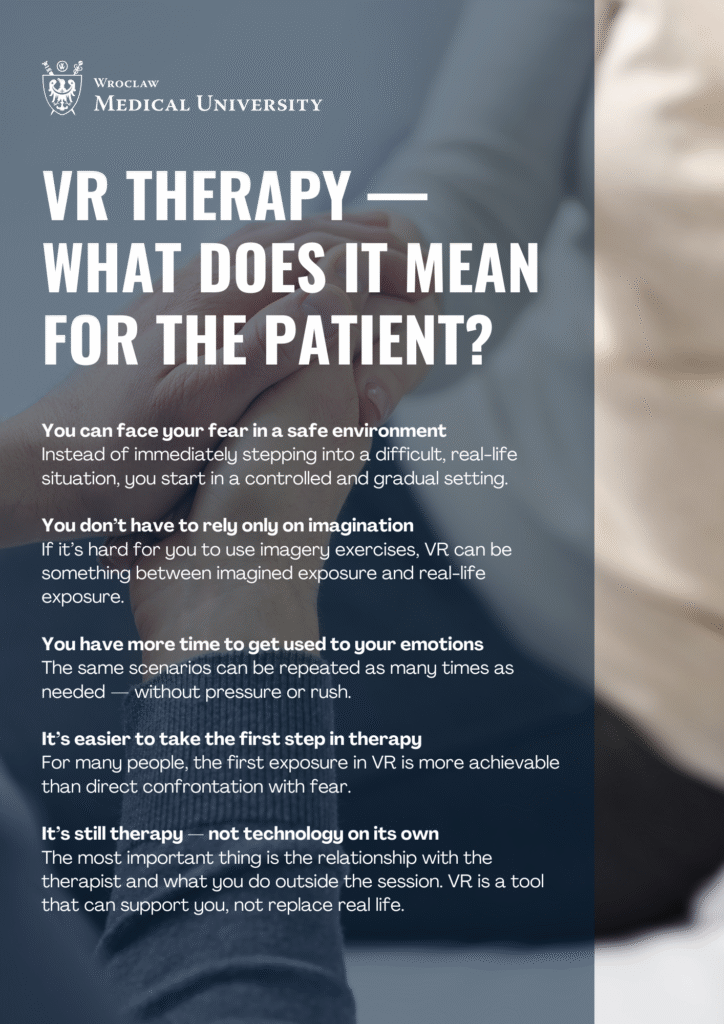
Imagine a therapy session in which the patient doesn’t just talk about their fear, but actually experiences it—standing on stage in front of an audience, sitting on an airplane, or entering a crowded room. Not in their imagination, but in an environment that engages their emotions so strongly that their body reacts as if the situation were real.
This is exactly what virtual reality (VR) offers, increasingly used as a supplement to cognitive-behavioral therapy (CBT). A review of studies shows that VR is a tool that changes how we work with patients, especially when confronting difficult emotions.
Therapy that “transports” the patient into a difficult situation
One of the foundations of cognitive-behavioral therapy is exposure, or gradually becoming accustomed to what triggers anxiety. The problem is that many such situations are difficult to recreate in a therapy office—after all, you can’t organize a plane flight or a speech in front of a large audience every day. This is where VR changes the game. As Dr. Luba Ślósarz from the Department of Humanistic Health Sciences at Wroclaw Medical University explains,
– This technology allows therapists to “transport” patients into realistic situations that would normally be difficult or impossible to recreate, while conducting exposure in a controlled and repeatable manner, enabling the therapist to observe reactions in real time and adjust the course of the session accordingly.
Importantly, VR is a blend of reality and imagination—less intense than a real-life experience, but far more immersive than mere visualization —which makes it an easier, more accessible starting point for many patients to begin working on their anxiety.
It works best where anxiety arises
Most of the evidence for VR’s effectiveness pertains to anxiety disorders—such as phobias, social anxiety, or PTSD. This is because, in these disorders, the key is the ability to gradually confront what triggers the anxiety and repeat this experience until the emotional reaction begins to subside.
As Dr. Magdalena Kazimierska-Zając emphasizes,
– VR allows for the very precise recreation of such situations and their repeated reenactment, which offers a significant advantage over traditional therapy, where it is not always possible to work “live” with a specific stimulus
At the same time, the researcher notes that while results in the area of anxiety disorders are well-documented, in the case of depression or addiction, we still lack sufficient data to draw definitive conclusions.
A bridge between avoidance and action
One of the most significant benefits of using VR is the reduction of avoidance—a mechanism that often perpetuates mental health issues and causes patients to postpone therapy or drop out early on.
As Dr. Luba Ślósarz notes,
– For many people, the very thought of a real confrontation with fear is too difficult, and VR creates a safer starting point and allows them to gradually become accustomed to difficult situations before they are ready to face them in reality.
Technology is not everything
Despite its great potential, VR is not a solution without limitations. In clinical practice, challenges remain in terms of equipment costs, access to appropriate software, and the need to train therapists.
As Dr. Magdalena Kazimierska-Zając emphasizes,.
– VR is not a tool that works on its own—its effectiveness depends on how it is integrated into the therapeutic process, and one must also be mindful of possible side effects, such as dizziness or nausea, which may limit its use in some patients.
And finally, the most important point: even the most realistic virtual environment cannot replace real life. The key element of therapy remains the transfer of acquired skills to everyday situations.
Everything points to the future of therapy being hybrid—combining face-to-face contact with a therapist with well-designed digital tools. VR could be one of the most important elements of this support, especially in situations where the emotional experience is key, rather than just conversation.
This material is based on the article:
Virtual Reality Technology in Cognitive Behavioral Therapy Across Multiple Psychiatric Conditions: A Narrative Literature Review
DOI: https://doi.org/10.2147/PRBM.S563502
Authors: Luba Ślósarz, Magdalena Kazimierska-Zając