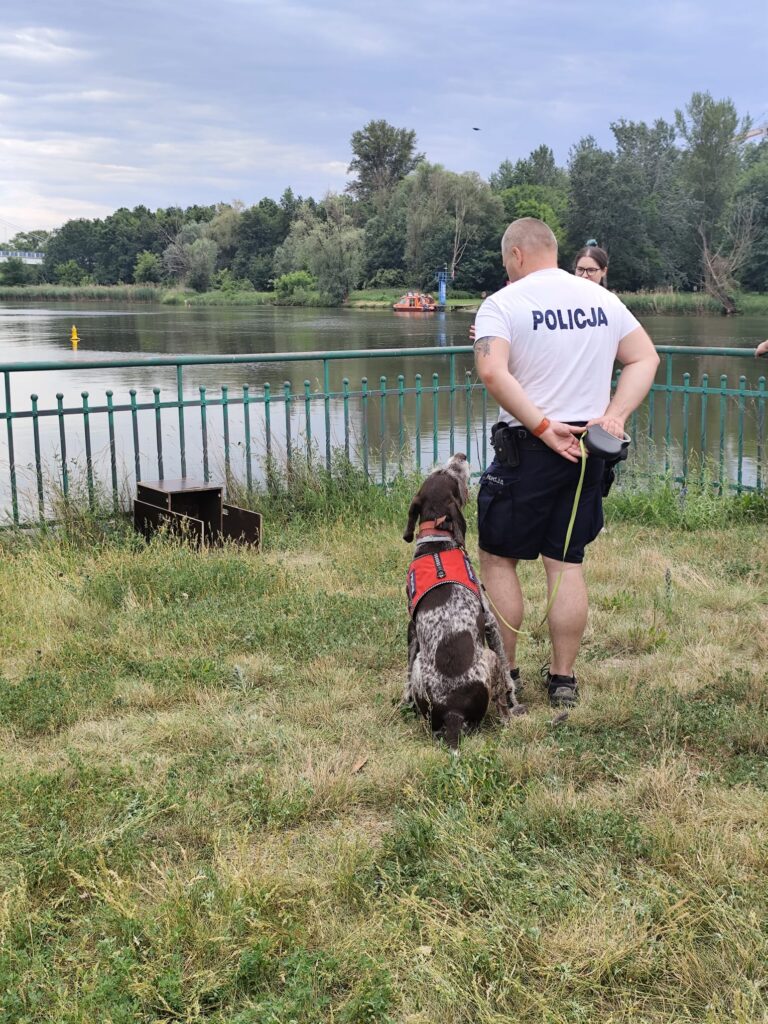

At the beginning of June, practical classes on the use of service dogs in search operations were held at the Wroclaw Medical University. The event was attended by students and representatives of law enforcement from the Water Police Unit of the Provincial Police Headquarters. The main highlight of the program was a demonstration of a police dog trained to locate human remains.
The training was organized within the international Erasmus+ program and served as an example of cooperation between the academic community and officers carrying out specialized field operations. Participants were able to familiarize themselves with procedures used during search activities conducted both on land and in bodies of water.
The scenario prepared by specialists included a presentation of various methods for locating sites where bodies may be hidden. Techniques used in forested and open areas were discussed, as well as operations involving searches where remains may be buried underground or located in aquatic environments. Significant attention was given to the role of service dogs, whose highly developed sense of smell allows them to detect traces imperceptible to humans.
During the exercises, the handler and their canine partner refined skills related to identifying characteristic odors produced during decomposition. Students had the opportunity to observe how environmental factors such as terrain, wind direction, humidity, and air temperature affect the dog’s effectiveness.
Organizers emphasized that understanding how scent disperses is one of the key elements of effective search operations. Proper interpretation of these phenomena enables dog-handler teams to more quickly define areas requiring detailed search.
The meeting also had an educational and practical dimension. It provided an opportunity for the exchange of experience between forensic medicine researchers and officers involved in search operations. Such cooperation supports the development of new working methods and improves the effectiveness of ongoing searches.
Police dogs have long been an essential support element for law enforcement. Depending on their specialization, they assist in locating missing persons, detecting narcotics, explosives, and traces left by offenders. They also play a crucial role in operations carried out near rivers, lakes, and other bodies of water, where their skills often determine the success of the mission.
Regular training and practical exercises help maintain a high level of proficiency in dog-handler teams and prepare them for the most demanding tasks. As a result, officers can rely on the effective support of their canine partners in situations where every minute counts.