

As recently as the mid-20th century, aging was described by Nobel Prize laureate Peter Medawar as “an unsolved problem in biology”. Today, scientists can analyze the activity of thousands of genes in individual cells, identify genetic variants associated with longevity, study molecular pathways affecting lifespan, and estimate biological age using epigenetic clocks. Experimental therapies using senolytics – compounds that eliminate some senescent cells – have also emerged. Paradoxically, however, the more we know about the biology of ageing, the more clearly we see how complex this process is.
The latest publication by Dr. Piotr Chmielewski from Wroclaw Medical University shows that ageing does not result from a single universal mechanism, but rather from dynamic interactions among many processes occurring at different levels of biological organization. The article, published in Biogerontology under the title “Ageing was never a singular problem in biology: implications for mechanisms, measurements and interventions”, offers a critical perspective on contemporary biogerontology.
The more we discover, the more questions arise
In recent decades, the biology of ageing has made progress that until recently seemed impossible. Scientists have uncovered the importance of the mTOR, AMPK, FOXO, and IGF-1 pathways, which regulate growth, metabolism, and lifespan. Epigenetic clocks based on DNA methylation patterns have been developed to estimate biological age, and advances in sequencing technologies have enabled the observation of ageing processes at the level of individual cells.
Never before have we known so much about the biology of ageing. Paradoxically, as knowledge grows, so does our awareness of the problem’s complexity. We understand individual mechanisms of aging increasingly well, yet we still do not know whether they form one common process or a set of partially independent processes leading to similar outcomes, – emphasizes Dr. Piotr Chmielewski.
According to the author, science is increasingly moving away from the search for a single universal cause of ageing. More and more evidence suggests that aging results from overlapping changes occurring simultaneously at many levels of biological organization.
Is there a primary cause of ageing?
For decades, various mechanisms have been proposed as potential primary drivers of ageing, including oxidative stress, DNA damage, telomere shortening, mitochondrial dysfunction, epigenetic changes, and chronic inflammation. Over time, however, it became clear that each of them explains only part of the age-related changes observed. Increasing evidence indicates that aging results from the interaction of many biological processes rather than a single universal mechanism.
All of these processes play an important role, yet none appears to explain the phenomenon in its entirety. Modern science is increasingly abandoning the search for a single cause of ageing. Research shows that ageing resembles the gradual disorganization of a complex biological system rather than a single failure resulting from one defect or program, – says the researcher.
This approach is reflected in the concept of the “hallmarks of ageing”, a set of interconnected biological characteristics and processes consistently associated with aging and potentially contributing to its course.
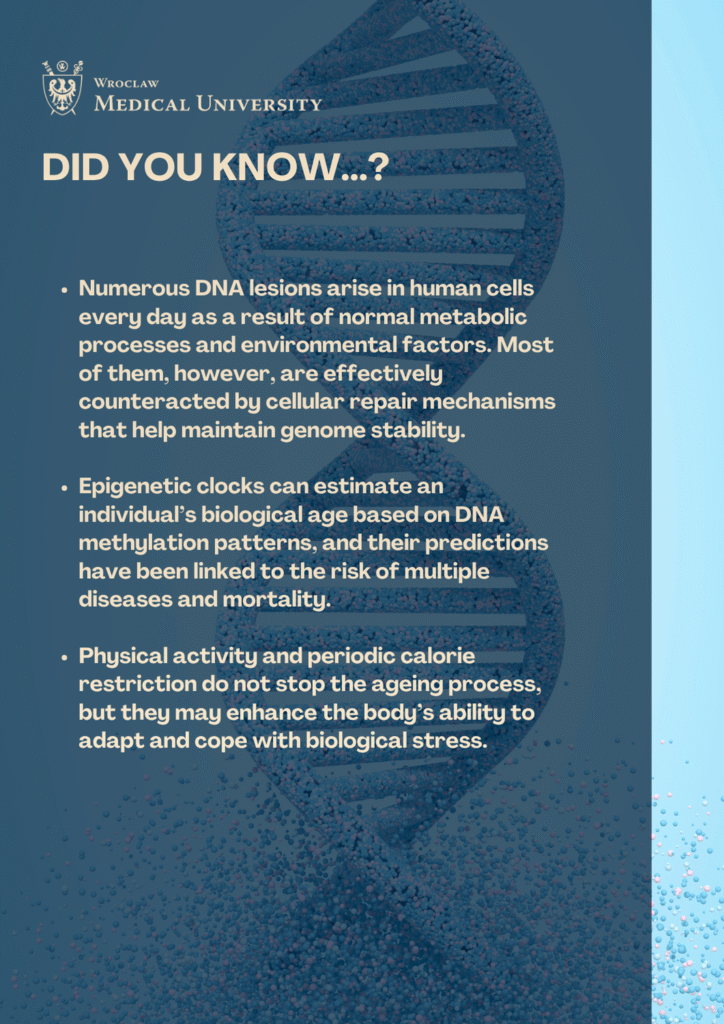
One of the most important achievements of modern biogerontology is the development of epigenetic clocks. Based on DNA methylation patterns, they can estimate biological age and are also associated with disease risk and mortality. However, this does not mean that scientists have discovered a biological “ageing counter”.
A fundamental question remains: do epigenetic clocks measure processes that directly participate in ageing, or do they primarily reflect changes caused by other biological mechanisms? In other words, would reversing epigenetic changes lead to genuine rejuvenation of the organism, or merely modify one of its biomarkers? – notes Dr. Chmielewski.
The answer to this question may determine whether future interventions truly influence the biological processes of ageing.
A mouse is not a miniature human
Laboratories around the world regularly report interventions that extend the lifespan of mice by 20–30 percent. Such results attract enormous attention, but their significance for human medicine remains limited.
However, we must remember that a mouse is not a miniature human. There are fundamental differences between mice and humans in lifespan, metabolism, the number of cell divisions, tissue organization, immune system function, and repair mechanisms, – emphasizes the scientist.
This is precisely why many promising anti-ageing therapies that work in laboratory animals fail to produce equally spectacular results in humans.
Youth is the ability to cope with damage
An increasing number of researchers believe that the most important feature of a young organism is not the absence of damage. Mutations, metabolic errors, and misfolded proteins occur throughout life. What may be crucial is the organism’s ability to repair and adapt effectively.
Perhaps the most important characteristic of youth is not a low level of damage, but a high capacity for adaptation, regeneration, and response to stress, – says Dr. Chmielewski.
This is why physical activity, calorie restriction, and intermittent fasting may provide health benefits. They do not eliminate ageing processes, but they may strengthen the body’s ability to adapt and compensate for damage, helping to maintain functional capacity for longer.
A new question in ageing research
According to the author, the greatest change currently taking place in biogerontology may concern not new technologies, but the way we think about ageing.
Perhaps the greatest change occurring today in ageing research is the shift from asking: “What causes ageing?” to asking: “How do some organisms manage to maintain functionality, resilience and adaptive capacity for so long despite constant damage and disturbances?”- concludes Dr. Piotr Chmielewski.
If this perspective proves correct, the future of ageing research may focus more on developing interventions that support the maintenance of health and functionality than on searching for a single solution to stop or reverse ageing.
Read more
This material is based on the article:
Author: Piotr Paweł Chmielewski
Biogerontology (2026)